My optometrist rocks. I've always been particular (ok, I'm fussy and picky) about my eyesight. Years ago another optometrist told me "you just want better than perfect vision". He was right, though he mainly was trying to get me to settle for the best that he could do. Not that he wasn't competent, but the technology at that time wasn't able to give me what I wanted.
When I moved to the city where I currently live, I crossed that threshold where my arms were continually shrinking whenever I held a book or newspaper. Eventually I concluded that age is "just a number", and succumbed to progressive focal length (aka "no-line bifocal") lenses. I got them at a "doc-in-a-box" chain, and I was pretty happy. The technicians warned me that it might take me some time to get used to them, and to be especially careful negotiating stairs until I was comfortable with them. Well, that took about 15 seconds, so I was a happy camper.
For awhile. The problem was, I was used to wearing contact lenses (rigid gas permeable or RGP), which gave me better acuity than spectacles. Plus, focusing a camera is more difficult with glasses for most people. I did the best I could until one of the temple pieces of my specs broke for the second time and couldn't be replaced. (Frame manufacturers build to the planned obsolescence/product churn model.) At this point I wanted to get rid of reading glasses when I wore my single-vision contacts.
So I went to a different eyedoc-in-the-box chain to see about progressive contact lenses. The assembly-line optometrist supplied me with single-vision soft contacts after stating that I wouldn't like multi-focal contacts. I believe he backed this up by quoting a statistic that only 20% of people can wear them or get on with them. Huh. Wonder where he got that statistic and by the way, 20% of what? If it's 20% of people who tried them and the only people who try them are brave souls who ignore an optometrist's opinions, then well ...
So those soft contacts didn't really do much for me. They were not as good as RGPs with a good script, and I decided I didn't like be pushed around by a snot-nose optometrist of a faceless corporate Eye-Mart. (No, it wasn't Wal-Mart, but it was the same mentality.) So I went back and demanded to get a trial pair of progressive contacts, which he grudgingly supplied.
Those are not "monocular" lenses wherein one lens is corrected for distance, the other for close focus. Each lens is truly progressive additive just like eyeglasses. Once they arrived and I tried them I knew this could work for me. The script wasn't quite right (thank you very much, Mr. + with-a-tailwind-optometry-graduate), and once again the resolution wasn't up to my standards because these were soft, not RGP. But now I knew I was on to something. So, I got a new pair of spectacles dispensed from another optometrist. I wasn't giving the dork any more of my money, and I chose a decent titanium frame.
So this is a really long way of leading up to my long-overdue visit to Tina Reeves, who runs a small optometry shop, and had come highly recommended. It was a recommendation I had ignored for a long time, figuring I couldn't afford her. But by now I wanted someone who really knew there stuff, someone who had a chance of getting me close to perfection.
First of all, did I say "my optometrist rocks"? Oh yeah, I did. Well, she does. First off, she got me a good script. I mean really, really good. I got some progressive RGP contacts and I was knocked out by how well they worked. People who say they don't work, or who say "I can't wear those" are wrong on the first count, and maybe wrong on the second. Some people can't wear RGPs, but for the life of me I can't understand it. Apparently there is something about tear production and/or the shape of the cornea ... I don't know. But I'm willing to be that a huge portion of people who think they can't wear them have never had a good fitting. While my insurance covered a good portion of my expense and my flexible spending benefit covered the rest, it was worth every penny, insurance or not.
Now I had confidence, and the next year when my script changed a bit, I got new contact lenses and my spectacles upgraded to the new script. But having kept up in her field, Tina could now source new RGP lens material that was easier to keep clean and wore longer without "gunking up". So reason #2 to stick with someone who really knows her shit, er stuff. (I kept the old pai of contacts for backup, which came in handy.)
The following year I upgraded to some really stylish Calvin Klein "frameless" frames (huh?), which make me look oh so suave... with good anti-reflective coating. These are the lightest most comfortable frames I've had, and they improve my looks, which is pretty easy. (Actually, I think it's pretty hard, in the sense that I think only a total redo of my face could actually do the job.)
Earlier this year, but well before my annual exam was due, Tina sent me an email about iZon lenses. The prospect of "high definition" vision drove me nuts, primarily because it was months before my insurance would kick in for the next exam and dispensing coverage. Aaargh! In the meantime, I figured out what these folks are doing. Their machine uses lasers to map the surface of each eye. It is the same wavefront technology that is used to guide Lasik and PRK keratometry, aka "laser surgery", to permanently correct ones vision. Only instead of reshaping your cornea with surgery, a custom lens is created for each eye that goes beyond the traditional script that corrects for power, astigmatism, etc. A thin-film polymer "lens" is created that is sandwiched between two layers of the lens material. Or at least, this is what I could deduce from my reading and Googling.
For months I anticipated the day, June 15 to be exact! that I could visit Tina and stick my face into the machine and have my eyes mapped with laser precision. Not that I needed an iPrint to create the excitement of a visit to Tina. Hell, Tina is such a joy to visit that I'd get an exam every day if I could. Who could want more than a rockin' rally car driver who loves her patients and exercises the highest degree of craft and knowledge to satisfy their vision care needs?
When I got my iPrint, it showed my right eye had a high degree of spherical, coma and trefoil aberration. The left eye had more moderate levels. This explained that while my old script was quite good (correction for 20/15 vision and excellent correction for astigmatism and presbyopia), my wife could still read street and highway signs yards before I could. Which, of course, made me seethe with optical jealousy. No matter how good the "normal" correction, those other nasty aberrations were not corrected with the precision of fine Leica or Zeiss glass ... even though one pair of my spectacles actually does have Zeiss material for the lenses.
Naturally, I ordered the iZon lenses for my Calvin Klein frames ... progressive additive power and multi-coating are included for the extra $100. But the big problem was THE WAIT. "Four to six weeks", the optician stated. The lenses are ground by a lab in San Diego, so my frames had to be shipped there, the lenses ground, returned etc.
Yet it is less than one month and as of today I now wear these new lenses. I have to admit, my first reaction was a bit of a let-down. Somehow the nose pads had been adjusted way too narrow, so they didn't sit right. The optician adjusted that, but once I got home, I decided the specs sit to high, so I need to go back.
More than that, I didn't see a shocking difference right away. For the first time in days, I had worn my contacts, and by the time I hit the optometrist at about 4:15, my eyeballs had adjusted to those, and it takes time for them to adjust back.
But after a few hours, and some fiddling with positioning, I began to see the difference. Sitting in the back yard and reading, I occasionally looked up to see what the world looks like. And gradually, I could see the difference. Yes, everything seems sharper. Colours are cleaner and purer, but not in an over-the-top rendering that is the bane of much of digital imaging. And as the natural light waned and the LED patio lights became more prominent ... even after a couple of gin-and-tonics I could really see the difference. It is not just the resolution, not just the absence of halos, smearing and flare. What struck me was the smooth tonal gradation that was just ... well, so natural. Some of the party lights we have are small LEDs that are surrounded by a paper-lantern type of shade. Looking at these lights carefully, there is no flare or smearing from the LED itself, and the gradation of the light transmitted through the shade material is just what it is... it is easy to visually define with the iZon lenses. I find it difficult to describe it in words. I can only compare it to a finely crafted b&w photograph, say Agfa APX100 film, 120 format, negatives carefully processed in Rodinal 1:100 so that micro-tonality is preserved throughout the entire brightness range. It's funny that I have seen this in good prints, but I don't think I've really seen it "live".
So, it's off to Tina to have the specs readjusted to sit properly on my face. Then off to Eastman House to see the Ansel Adams exhibit again. I saw it last weekend and was really thrilled. But now I'm really going to see it.
Oh, and I'm going to take more pictures. I have a feeling my prints and final files for display may change a bit. At least I hope so.
Tuesday, July 10, 2007

Sunday, June 24, 2007



Wednesday, June 06, 2007
The Internal Audience
I get a kick out of pulling out cameras that are older than the person to whom I am showing them. The reactions are entertaining, but surprisingly (at least it might be surprising to a lot of people,) the reaction is often "Wow, that's so cool!" Given my age, it's at least possible that they are humouring me, and it's also possible that since I am a support resource for many of them they want to insure I give them good service, so they feign their delight. But I don't think so much ... the designs and craftsmanship are classic and solid. Today's tiny pocket digicams don't have heft and solidity, and the larger DSLRs are so plastic and cold.
But there is another factor. Over on RFF, we have noticed a real influx of younger photographers and new photo enthusiasts who have moved over not only to film shooting, but in amazing numbers to mechanical or "simple" electronically controlled cameras. These are people who have at best a vague notion of film, and certainly have grown up with digital cameras as the only photo capture device they knew, or at the very least they desired a "good" digital camera because of the marketing and word-of-mouth hype.
So why are they turning to film cameras, and to rangefinders, of all things? I think one answer is in how current products are designed and implemented. The New York Times has a great article on "feature creep" and the "internal audience syndrome", which plagues marketing and engineering departments.
A still camera is a pretty simple device. It is intended to capture a moment and a composition to a sensitive material or subsystem so that the resulting image can be reproduced for any number of purposes. The physics dictate a lens opening, an exposure duration and some means of transferring the captured image to other media.
Figuring out the exposure duration and lens opening size (aperture) takes some knowledge, so a light meter is used to help. In truth, exposures can be calculated in one's head if the sensitivity of the capture medium is known. Interior and night lighting is more difficult, since our eyes are so adaptable to lower light levels and there is little or no reference point to the sun's intensity.
Most cameras with even moderately sophisticated internal metering systems do a very good job of evaluating the required exposure, and when a scene has "tricky" lighting, a minimally knowledgeable photographer can compensate for the meter which has been fooled.
But in an effort to relieve snap-shooters of having to know anything about exposure rules, manufacturers have tried to design logic via electronics and more sophisticated light measurement techniques to do the work of the human brain. Some efforts have been very successful, but funnily enough it's not simply the newest systems that are the best. The Yashica rangefinder models such as the GSN had metering systems that were, by all accounts, hardly ever fooled, yet those cameras were produced in the 1960s and 1970s.
So when my friend DOF posted about his plan to purchase an Olympus SW-710 because of its rugged, waterproof construction, the quality of the images and such, one commenter advised he reconsider because of a published "bad review". Ooops! If you know DOF, you know he does his homework. I'm sure he'll make that camera dance.
My needs are a bit different. If I am forced to go digital, or choose to do so, I want:
But there is another factor. Over on RFF, we have noticed a real influx of younger photographers and new photo enthusiasts who have moved over not only to film shooting, but in amazing numbers to mechanical or "simple" electronically controlled cameras. These are people who have at best a vague notion of film, and certainly have grown up with digital cameras as the only photo capture device they knew, or at the very least they desired a "good" digital camera because of the marketing and word-of-mouth hype.
So why are they turning to film cameras, and to rangefinders, of all things? I think one answer is in how current products are designed and implemented. The New York Times has a great article on "feature creep" and the "internal audience syndrome", which plagues marketing and engineering departments.
A still camera is a pretty simple device. It is intended to capture a moment and a composition to a sensitive material or subsystem so that the resulting image can be reproduced for any number of purposes. The physics dictate a lens opening, an exposure duration and some means of transferring the captured image to other media.
Figuring out the exposure duration and lens opening size (aperture) takes some knowledge, so a light meter is used to help. In truth, exposures can be calculated in one's head if the sensitivity of the capture medium is known. Interior and night lighting is more difficult, since our eyes are so adaptable to lower light levels and there is little or no reference point to the sun's intensity.
Most cameras with even moderately sophisticated internal metering systems do a very good job of evaluating the required exposure, and when a scene has "tricky" lighting, a minimally knowledgeable photographer can compensate for the meter which has been fooled.
But in an effort to relieve snap-shooters of having to know anything about exposure rules, manufacturers have tried to design logic via electronics and more sophisticated light measurement techniques to do the work of the human brain. Some efforts have been very successful, but funnily enough it's not simply the newest systems that are the best. The Yashica rangefinder models such as the GSN had metering systems that were, by all accounts, hardly ever fooled, yet those cameras were produced in the 1960s and 1970s.
So when my friend DOF posted about his plan to purchase an Olympus SW-710 because of its rugged, waterproof construction, the quality of the images and such, one commenter advised he reconsider because of a published "bad review". Ooops! If you know DOF, you know he does his homework. I'm sure he'll make that camera dance.
My needs are a bit different. If I am forced to go digital, or choose to do so, I want:
- A smallish yet rugged, metal-bodied camera
- Rangefinder focusing; if I must have a dSLR, then manual focusing must be straighforward, positive and precise.
- A viewfinder that is the equal of a Leica or the Olympus 35SP, or an Olympus OM-1
- Small, compact prime lenses with fast prime choices
- As little automation as possible
- An interface that presents a minimal number of controls that are analog in presentation and operation. Multiple, nested menus are NOT acceptable
Friday, June 01, 2007
"Just the facts, ma'am"
Facts can be slippery things. Well, actually "real" facts are not slippery at all, but getting to the facts can be difficult, not least when the "facts" are statistical in nature.
Canada's Public Safety Minister, Stockwell Day (aka "Doris") has responded to Ontario's request for a federal ban on handguns by arguing, as quoted in The Toronto Star, that availability of handguns aren't the real problem. Part of his argument:
Canada's Public Safety Minister, Stockwell Day (aka "Doris") has responded to Ontario's request for a federal ban on handguns by arguing, as quoted in The Toronto Star, that availability of handguns aren't the real problem. Part of his argument:
Thursday, May 03, 2007
Scotland Should be Free
Yes, it has been forever since the last entry. I am working on selling off a passle of photo gear to fund the acquisition of a film scanner, most likely the Nikon Coolscan V. Once that is accomplished, I can work on a large backlog of negatives and slides to be posted here, on flickr and RFF, etc.
In the meantime, tonight I am watching the election results in Scotland, where it currently appears that the Scottish National Party (SNP) have significant gains and may form the majority in the Scottish Parliament.
As a party whose major policy plank is Scottish Independence, I am quite pleased, as I believe Scottish independence is a desirable development.
All the returns are not yet in, but I am hopeful, and congratulate the SNP on the results so far.
Slainte!
In the meantime, tonight I am watching the election results in Scotland, where it currently appears that the Scottish National Party (SNP) have significant gains and may form the majority in the Scottish Parliament.
As a party whose major policy plank is Scottish Independence, I am quite pleased, as I believe Scottish independence is a desirable development.
All the returns are not yet in, but I am hopeful, and congratulate the SNP on the results so far.
Slainte!
Sunday, February 18, 2007
The Newest 3rd World Country
We usually think of countries emerging from "3rd world" status. But obviously countries, as a result of a series of events and mishaps, can devolve into that status. And we usually think of 3rd world status as primarily economic condition, with bad government and corruption as secondary conditions. In reality, of course, the situation is often the reverse: decline into economic failure is caused by bad government, corruption, etc.
Yesterday afternoon my wife and I watched Hacking Democracy, an HBO production that left me at once angry, despairing, disgusted and again angry. Yes, I have known about the problems with electronic voting systems in general, and the serious issues with Deibold in particular. But before watching Hacking Democracy, I didn't really know the details, I didn't know how shocking the situation is. And it's not just Diebold; Velousia county in Florida clearly demonstrated that the rot goes all the way to the core of your electoral systems and personnel.
Now I know which country is the latest to "achieve" 3rd world status.
Yesterday afternoon my wife and I watched Hacking Democracy, an HBO production that left me at once angry, despairing, disgusted and again angry. Yes, I have known about the problems with electronic voting systems in general, and the serious issues with Deibold in particular. But before watching Hacking Democracy, I didn't really know the details, I didn't know how shocking the situation is. And it's not just Diebold; Velousia county in Florida clearly demonstrated that the rot goes all the way to the core of your electoral systems and personnel.
Now I know which country is the latest to "achieve" 3rd world status.
Wednesday, February 14, 2007
The Russians Came
... and left us a gift.
I remember when Fed and Zorki cameras were at least mentioned in Modern Photography or Popular Photography (gee, I really miss Modern) as pathetic alternatives to a Leica or a Contax. OK, they didn't use the word pathetic, but the idea was there. The knock against Soviet photographic equipment was its reliability issues. I.e., make sure your camera was made on a Wednesday, else it was too vodka-soaked to be useful.
There was some merit to that, but it wasn't the whole story. Through my membership at Rangfinder Forum, I have gained a new appreciation with FSU (Former Soviet Union) photo gear. Until recently, however, it was an academic appreciation. Then someone sold me a Mamiya 1000DTL camera with 50mm Mamiya lens, and a Carl Zeiss Jena 135/f3.5 lens as a bonus (made in East Germany during the soviet era) ... the CZJ is a VERY sharp lens:

This shot was form the CZJ mounted with an M42 adapter onto an OM-1n. That setup doesn't allow for infinity focus, only close focus (e.g., "macro) shots. The CZJ 135/3.5 has pretty close focusing anyway, so this is a pretty useful rig, albeit requiring stopdown metering.
As a result of the close focus and large aperture, this shot shows very limited depth of field. But what is in focus is wicked sharp.
Next, I acquired a 58mm/f2 Helios lens, also in M42 (Practica/Pentax) screw mount. My friend Gene Wilburn (Harbourlight on flickr) had posted some shots with this lens that really impressed me. It turns out a co-worker had one that he considered spare, so he gave it to me. Whoo hoo!
One freezing Sunday in January I went out to the High Falls district in Rochester and made a few shots, mounted on the aforementioned Mamiya-Sekor 1000DTL. Most shots were either wide-open or near full aperture. I wanted to see how sharp it was at maximum aperture, as well as gauge the "bokeh", i.e. the characteristics of the out of focus areas.


Some of the blurriness in the last shot is from the long exposure combined with falling sleet. My butt got wet on this shoot.
Film was a private label of Agfa Vista 200. Sadly, Agfa no longer manufactures photographic film. This particular emulsion was a real winner.
The Industar 61 is perhaps an even better lens (albeit slower at f/2.8), so I think I'll have to get one of those, too.
I remember when Fed and Zorki cameras were at least mentioned in Modern Photography or Popular Photography (gee, I really miss Modern) as pathetic alternatives to a Leica or a Contax. OK, they didn't use the word pathetic, but the idea was there. The knock against Soviet photographic equipment was its reliability issues. I.e., make sure your camera was made on a Wednesday, else it was too vodka-soaked to be useful.
There was some merit to that, but it wasn't the whole story. Through my membership at Rangfinder Forum, I have gained a new appreciation with FSU (Former Soviet Union) photo gear. Until recently, however, it was an academic appreciation. Then someone sold me a Mamiya 1000DTL camera with 50mm Mamiya lens, and a Carl Zeiss Jena 135/f3.5 lens as a bonus (made in East Germany during the soviet era) ... the CZJ is a VERY sharp lens:

This shot was form the CZJ mounted with an M42 adapter onto an OM-1n. That setup doesn't allow for infinity focus, only close focus (e.g., "macro) shots. The CZJ 135/3.5 has pretty close focusing anyway, so this is a pretty useful rig, albeit requiring stopdown metering.
As a result of the close focus and large aperture, this shot shows very limited depth of field. But what is in focus is wicked sharp.
Next, I acquired a 58mm/f2 Helios lens, also in M42 (Practica/Pentax) screw mount. My friend Gene Wilburn (Harbourlight on flickr) had posted some shots with this lens that really impressed me. It turns out a co-worker had one that he considered spare, so he gave it to me. Whoo hoo!
One freezing Sunday in January I went out to the High Falls district in Rochester and made a few shots, mounted on the aforementioned Mamiya-Sekor 1000DTL. Most shots were either wide-open or near full aperture. I wanted to see how sharp it was at maximum aperture, as well as gauge the "bokeh", i.e. the characteristics of the out of focus areas.


Some of the blurriness in the last shot is from the long exposure combined with falling sleet. My butt got wet on this shoot.
Film was a private label of Agfa Vista 200. Sadly, Agfa no longer manufactures photographic film. This particular emulsion was a real winner.
The Industar 61 is perhaps an even better lens (albeit slower at f/2.8), so I think I'll have to get one of those, too.
Tuesday, February 13, 2007
Hillary's Chances
My friend Decrepit Old Fool (DOF) recently blogged about why he is not enthusiastic about Hillary Clinton as a candidate for the Democratic nomination. This was in response to a private email I had sent him asking why, in a previous post, he had used the word "Ugh" in connection with Hillary as a candidate.
I thought his blog post was thoughtful and pretty interesting. I think it fairly sums up the feelings of a lot of people, at least those who are not irrationally rabid about Ms. Clinton. (Naturally, some of the regulars on DOF's blog chimed in with toss-offs about Hillary. They are mild in comparison to what is to come from the loonie right fringe, of course, but they were "entertaining" nonetheless.)
However, I wanted to respond, with this proviso: I am not supporting Hillary. First of all, I think it is far too early (for me at least) to choose a candidate. There has been no real dialogue, much less actual debate among the Democratic hopefuls. I have promised myself that I will be deliberate and thoughtful before making a personal choice. As if anyone cares.
So, a few highlights from DOF's post, with my comments...
Right. Pretty much same here. I did like Bill all along, though from time to time I had some doubts regarding policy. (The blue dress incident was a total non-issue to me. Anyone who truly believes the affair rose to the level of impeachment is, IMO, either totally lacking in understanding of the constitution or an outright idiot. Flame on, right wing.)
My suggestion here is that Hillary may really surprise some people, too. Just as so many underestimated her husband, thinking he only won on charisma, don't count out Hillary because she lacks that charisma and warmth. FWIW, my opinion is that she does have some of those characteristics in person. No I haven't met her, but reports from those who have met her/know her indicate she's different in person, it's her people who are remote, aloof, etc. Yes, she has chosen those people, so I fault her there. But still, I do not regard the public media as my lens of choice for critical evaluation. I simply suggest we listen to what she says, and dispense with everything else, at least as much as possible.
Further down DOF writes: "You can make a very strong case that voters always go for the more charismatic candidate regardless of ideology. Bill Clinton has it - he could work around almost any gaffe or misdeed. Hillary does not, and her candidacy virtually guarantees a Republican president in ‘08. I do believe Hillary is smart enough to realize this, which in my mind makes her candidacy self-indulgent and unprincipled. "
I disagree completely. Judging what Hillary does or does not realize is somewhat arrogant, IMO.
Overall I'm understanding of the "no charisma/warmth" POV, but can't award any points, especially in light of the latter judgment.
I recently received a "joke" email (from a relative who knows I'm a liberal, yet!) that had a photo of a KFC store whose sign denigrated Hillary based on her thighs. In the text of the email, i.e. not part of the actual "joke", was the admonition "Even if you're a Democrat, you have to admit this is funny." No, it's not funny. When serious political discourse, the choice of the leader of the most potent military force in the world (at this point) degenerates to mean, sexist attacks, it is not funny. I am so tired of attacks (by either side), of meanness, of disrespect, that sometimes it physically hurts.
But beyond that, I have to hope that any Democratic nominee will be able to rise above those attacks; respond in a timely fashion (unlike Kerry), yes, but speak to the real issues, to what is important.
Yes, sliding all the burden of the cost of carbon production solely to the corporations is not the right tactic. But I am reasonably certain that is not Hillary's only plank in her energy platform. More than that, though, is you have to start somewhere, and corporations are a huge part of the production of our carbon burden. Competition and innovation will make sure the cost of becoming more environmentally responsible is not simply passed on to the consumer. Sorry, but that is an old, tired and wrong argument. It is the bleating of the right wing that claims to be "conservative" yet wants to live off the benefit of what amounts to a subsidy. "We produce products in a dirty manner, you the consumer pay the price, thanks to government abandoning their responsibility to protect the common good." If we used the argument of the cost just being passed on to the consumer to prevent regulation of environmental concerns, we'd still be using freon for air conditioning.
I'll grudgingly grant 1/4 point here. I am tempted to go a whole 1/2 point, but I'm not feeling magnanimous.
Midwest farmers will love that, but it makes no sense in terms of energy. In addition to the input requirements, corn requires huge amounts of water, herbicides and pesticides to produce in industrial quantities. So it doesn't make any sense on other environmental grounds, either.
Obama also favours the development of "clean coal" technology. Huh? We've heard this drumbeat forever, it seems. Turning from one non-renewable source for another doesn't make any sense to me. And the issue of what is "clean" is complex enough, subject to statistical justification, that the average Joe will glaze over and say "Yeah, makes sense" even if it is black magic.
I see nothing in Obama's platform, as published on his website, that speaks to the environment in real terms. And it doesn't begin to address DOF's recommendation:
"Alternative energy research will benefit all Americans, so there’s a good case for all Americans paying for it, not just evil corporations"
The only time Americans will "get it" is when real conservation, real change becomes necessary.
So, does this make me anti-Obama? No. He has just started, I'm sure he will expand and fill out his position on issues. As for Hillary's website, it's pretty disappointing if you want to read position statements, her platform proposals. Apparently all such information is in the transcripts of speeches or in news articles and news releases. It's not very user friendly, IMO. (Oh, and by the way, I'm thinking Hillary is pretty educated on the Constitution as well. Before she was the First Lady, she gathered some pretty impressive credentials, including sitting as a staffer on the House Judiciary Committee that handled the impeachment of Richard M. Nixon.)
But still, I would encourage people to not come to conclusions about Hillary until the campaigns have worked their way through the course of debate, caucuses and primaries. And focus on what candidates say on the issues, not just judgment calls on what one infers about their motivation. That's always rocky ground.
I thought his blog post was thoughtful and pretty interesting. I think it fairly sums up the feelings of a lot of people, at least those who are not irrationally rabid about Ms. Clinton. (Naturally, some of the regulars on DOF's blog chimed in with toss-offs about Hillary. They are mild in comparison to what is to come from the loonie right fringe, of course, but they were "entertaining" nonetheless.)
However, I wanted to respond, with this proviso: I am not supporting Hillary. First of all, I think it is far too early (for me at least) to choose a candidate. There has been no real dialogue, much less actual debate among the Democratic hopefuls. I have promised myself that I will be deliberate and thoughtful before making a personal choice. As if anyone cares.
So, a few highlights from DOF's post, with my comments...
- "I didn’t appreciate Bill enough while he was in office, but Bush cured me of it."
Right. Pretty much same here. I did like Bill all along, though from time to time I had some doubts regarding policy. (The blue dress incident was a total non-issue to me. Anyone who truly believes the affair rose to the level of impeachment is, IMO, either totally lacking in understanding of the constitution or an outright idiot. Flame on, right wing.)
My suggestion here is that Hillary may really surprise some people, too. Just as so many underestimated her husband, thinking he only won on charisma, don't count out Hillary because she lacks that charisma and warmth. FWIW, my opinion is that she does have some of those characteristics in person. No I haven't met her, but reports from those who have met her/know her indicate she's different in person, it's her people who are remote, aloof, etc. Yes, she has chosen those people, so I fault her there. But still, I do not regard the public media as my lens of choice for critical evaluation. I simply suggest we listen to what she says, and dispense with everything else, at least as much as possible.
Further down DOF writes: "You can make a very strong case that voters always go for the more charismatic candidate regardless of ideology. Bill Clinton has it - he could work around almost any gaffe or misdeed. Hillary does not, and her candidacy virtually guarantees a Republican president in ‘08. I do believe Hillary is smart enough to realize this, which in my mind makes her candidacy self-indulgent and unprincipled. "
I disagree completely. Judging what Hillary does or does not realize is somewhat arrogant, IMO.
Overall I'm understanding of the "no charisma/warmth" POV, but can't award any points, especially in light of the latter judgment.
- "But Hillary’s vote for the Iraq war seems unprincipled."
- "Then there’s economics: her husband understands the profit motive, and so does Al Gore. They regard taxes and regulations as necessary things, but they also recognize that capitalism is pulling this wagon, and to keep it well fed. What about Hillary?
“I want to take those profits, and I want to put them into a strategic energy fund...”"
I recently received a "joke" email (from a relative who knows I'm a liberal, yet!) that had a photo of a KFC store whose sign denigrated Hillary based on her thighs. In the text of the email, i.e. not part of the actual "joke", was the admonition "Even if you're a Democrat, you have to admit this is funny." No, it's not funny. When serious political discourse, the choice of the leader of the most potent military force in the world (at this point) degenerates to mean, sexist attacks, it is not funny. I am so tired of attacks (by either side), of meanness, of disrespect, that sometimes it physically hurts.
But beyond that, I have to hope that any Democratic nominee will be able to rise above those attacks; respond in a timely fashion (unlike Kerry), yes, but speak to the real issues, to what is important.
Yes, sliding all the burden of the cost of carbon production solely to the corporations is not the right tactic. But I am reasonably certain that is not Hillary's only plank in her energy platform. More than that, though, is you have to start somewhere, and corporations are a huge part of the production of our carbon burden. Competition and innovation will make sure the cost of becoming more environmentally responsible is not simply passed on to the consumer. Sorry, but that is an old, tired and wrong argument. It is the bleating of the right wing that claims to be "conservative" yet wants to live off the benefit of what amounts to a subsidy. "We produce products in a dirty manner, you the consumer pay the price, thanks to government abandoning their responsibility to protect the common good." If we used the argument of the cost just being passed on to the consumer to prevent regulation of environmental concerns, we'd still be using freon for air conditioning.
I'll grudgingly grant 1/4 point here. I am tempted to go a whole 1/2 point, but I'm not feeling magnanimous.
- "So what about Obama? He is a constitutional scholar, he respects the conservative world view, he has charisma, he knows history, and he is able to hold his temper under extreme provocation. In other news, I recently found out he smokes cigarettes, which moves him up a notch in my book. Illogical as it sounds, I don’t trust people who appear saintly."
Midwest farmers will love that, but it makes no sense in terms of energy. In addition to the input requirements, corn requires huge amounts of water, herbicides and pesticides to produce in industrial quantities. So it doesn't make any sense on other environmental grounds, either.
Obama also favours the development of "clean coal" technology. Huh? We've heard this drumbeat forever, it seems. Turning from one non-renewable source for another doesn't make any sense to me. And the issue of what is "clean" is complex enough, subject to statistical justification, that the average Joe will glaze over and say "Yeah, makes sense" even if it is black magic.
I see nothing in Obama's platform, as published on his website, that speaks to the environment in real terms. And it doesn't begin to address DOF's recommendation:
"Alternative energy research will benefit all Americans, so there’s a good case for all Americans paying for it, not just evil corporations"
The only time Americans will "get it" is when real conservation, real change becomes necessary.
So, does this make me anti-Obama? No. He has just started, I'm sure he will expand and fill out his position on issues. As for Hillary's website, it's pretty disappointing if you want to read position statements, her platform proposals. Apparently all such information is in the transcripts of speeches or in news articles and news releases. It's not very user friendly, IMO. (Oh, and by the way, I'm thinking Hillary is pretty educated on the Constitution as well. Before she was the First Lady, she gathered some pretty impressive credentials, including sitting as a staffer on the House Judiciary Committee that handled the impeachment of Richard M. Nixon.)
But still, I would encourage people to not come to conclusions about Hillary until the campaigns have worked their way through the course of debate, caucuses and primaries. And focus on what candidates say on the issues, not just judgment calls on what one infers about their motivation. That's always rocky ground.
Saturday, January 20, 2007
Hillary is In
Hillary Clinton is in. With Barak Obama set to make an official announcement on Feb. 11 in Springfield, IL (and as much as I respect Obama, I think that is just a shade too cute), Bill Richardson contemplating running, the Democratic race will take on a character unlike any other. The diversity of candidates will finally, finally reflect an "America" (actually, the United States of America ... there are several other countries in the Americas, and all their citizens are "Americans" in actuality) that has changed radically in the last 50 years. Yet this race will be the first to truly reflect those demographic and social changes.
As I stated in my blog submission on Mrs. Clinton's website (see below,) I believe the most important aspect of the upcoming campaign will be her ability to reach out and have a dialog amongst all the electorate. I am one of the rare few who are ambivalent about her candidacy, because while I share most of her views, most of her record and admire her intellect and work ethic, the ability to overcome divisiveness is perhaps as important as policy and legislative agenda.
First of all, I want to congratulate you for your conviction and determination that have led you to enter this race. Regardless of the outcome, I believe that the very presence of a woman of such qualification and experience, one who has a real chance to win, is very important to the U.S.
That said, I am one of the few who is, at this moment, ambivalent about a Hillary Clinton presidency. Mrs. Clinton, please make it a top priority to demonstrate how you can be a great President, not only in terms of policy and leadership, but in reaching out to and including those who strongly oppose you. While there will always be divisions among the body politic, we need someone with the strength and compassion to lead in spite of divisions, to not revile, marginalize nor denigrate those who strongly oppose.
I am US born, but as a young adult took out Canadian citizenship after living for a long time in southern Ontario. As a result of the trends in American politics and society (starting with the Vietnam war ... and no, I was not a draft dodger,) I now consider myself a Canadian first. I sincerely hope that the dialog resulting from your campaigning, from the national discussion which is so vital at this time, restores my faith in the United States.
As I stated in my blog submission on Mrs. Clinton's website (see below,) I believe the most important aspect of the upcoming campaign will be her ability to reach out and have a dialog amongst all the electorate. I am one of the rare few who are ambivalent about her candidacy, because while I share most of her views, most of her record and admire her intellect and work ethic, the ability to overcome divisiveness is perhaps as important as policy and legislative agenda.
First of all, I want to congratulate you for your conviction and determination that have led you to enter this race. Regardless of the outcome, I believe that the very presence of a woman of such qualification and experience, one who has a real chance to win, is very important to the U.S.
That said, I am one of the few who is, at this moment, ambivalent about a Hillary Clinton presidency. Mrs. Clinton, please make it a top priority to demonstrate how you can be a great President, not only in terms of policy and leadership, but in reaching out to and including those who strongly oppose you. While there will always be divisions among the body politic, we need someone with the strength and compassion to lead in spite of divisions, to not revile, marginalize nor denigrate those who strongly oppose.
I am US born, but as a young adult took out Canadian citizenship after living for a long time in southern Ontario. As a result of the trends in American politics and society (starting with the Vietnam war ... and no, I was not a draft dodger,) I now consider myself a Canadian first. I sincerely hope that the dialog resulting from your campaigning, from the national discussion which is so vital at this time, restores my faith in the United States.
Monday, November 27, 2006
Old (some) glass on a modern digital camera
Lenses made for film cameras are not always optimal for digital cameras, or at least the theory goes. One contributor on Rangefinder Forum did an interesting comparison of four different 50mm lenses on the Epson R-D1, a digital rangefinder camera which takes lenses made for the Leica M mount.
The lenses were Cosina Voigtlander Nokton 50mm f1.5, Canon 50mm f1.4, Canon 50mm f1.2 and Canon 50mm f0.95. In most cases, the Canon 0.95 was the best, in my eyes and given the conditions of the test. This is quite astonishing for a lens first marketed in 1961.

I'd be quite pleased to have the R-D1 as a digital camera. It makes nice images, it's b&w mode is remarkable, and it (mostly) meets my requirements for camera design. That said, it is not inexpensive, even if you can get a refurb directly from Epson at roughly 50% off. In addition, Epson QC and customer support for the R-D1 is problematic.
So this proves I'm not totally anti-digital. If money were no object, I'd have an R-D1 and some nice Canon ... or Leica ... or Zeiss glass.
The lenses were Cosina Voigtlander Nokton 50mm f1.5, Canon 50mm f1.4, Canon 50mm f1.2 and Canon 50mm f0.95. In most cases, the Canon 0.95 was the best, in my eyes and given the conditions of the test. This is quite astonishing for a lens first marketed in 1961.

I'd be quite pleased to have the R-D1 as a digital camera. It makes nice images, it's b&w mode is remarkable, and it (mostly) meets my requirements for camera design. That said, it is not inexpensive, even if you can get a refurb directly from Epson at roughly 50% off. In addition, Epson QC and customer support for the R-D1 is problematic.
So this proves I'm not totally anti-digital. If money were no object, I'd have an R-D1 and some nice Canon ... or Leica ... or Zeiss glass.
Saturday, November 25, 2006
Yet another "anti-digital" rant.
Over on Decrepit Old Fool, I posted this mini-rant (copied below) about digital cameras. This post was prompted by skimming and then posting in response to the Stupid Evil Bastard entry about choosing a digital camera. Here's my DOF comment:
In a positive vein, both Fuji and Kodak have introduced some new films, OK, at least they're reformulated. Kodak re-did their Portra emulsions, and Fuji has re-introduced Velvia 50 Professional. Kodak offered free samples of the Portra on their website. They didn't publicize the promotion, but when word got out they had 33,000 people sign up. Limited to US distribution, their expected response was 22,000. Some folks got 35mm instead of 120, and vice versa, and are whining about it. I got two rolls of each, so I'm fine, but even if they had got it wrong, I wouldn't complain about getting free film from a company that is apparently abandoning film. Or at least, the CEO wants to, but somehow Mary Jane Hellyer sneaked in some R&D to improve the products. Judging by the response from real photographers, she knows something Antonio Perez doesn't.
OK, I'm not, deep down, anti-digital. The two technologies are just different, and analog/film photography has about a 100 year lead on digital. The people driving digital imaging seem to me to be non-photo marketing types. Say what you will about Kodak, but for years there were a lot of Kodakers who were committed to image quality and advancing photography as an important social endeavor. Yeah, yeah, they still had marketing types who got their 2 cents in, and were burdened by more layers of middle management than an onion.
And they certainly weren't the holy grail in all areas. I remember when they really screwed up black & white papers. Their initial move to resin coated papers and the cut in silver content during the mid-70s lost me. I went to Ilford for most of my b&w material and stayed there with the exception of Tri-X for film. And I discovered Agfa transparency films, along with Agfapan/APX 100 b&w film. Agfachrome was, for me, better than any Kodak colour slide film except for Kodachrome. But Agfa is gone, and Kodak, Ilford & Fuji remain.
So for now I applaud Kodak for paying at least some attention to film. I'd say Mary Jane has more balls than Antonio.
I registered at SEB just so I could post a (fairly mild) “digital sux” rant. :D
Zuiko glass is great, but I’m now hankering for some Leica glass and a http://cameraquest.com/VCBT.htm. Is that just not the coolest looking rig you’ve ever seen? Hey NikCanon, why can’t you design cameras that look and feel so good that I am drawn to them, want to just pick ‘em up and GO.
Leica has done it with the M8. Despite some significant technical issues and Leica fumbling the launch of the camera, it could set a new standard for digital photography. Now we need a follow-on (Cosina Voigtlander? Zeiss?) that will make available a stellar but more “popularly priced” digital camera that will make Canon, Nikon, Fuji and even Olympus sweat.
If Maitani were still at work, it would be a done deal. That’s the sadness to me. There are no more real visionaries designing cameras. I know that’s a bit of hyperbole, but it’s how I feel.
DOF and some others will probably tell me to "give it a rest", but I don't care.In a positive vein, both Fuji and Kodak have introduced some new films, OK, at least they're reformulated. Kodak re-did their Portra emulsions, and Fuji has re-introduced Velvia 50 Professional. Kodak offered free samples of the Portra on their website. They didn't publicize the promotion, but when word got out they had 33,000 people sign up. Limited to US distribution, their expected response was 22,000. Some folks got 35mm instead of 120, and vice versa, and are whining about it. I got two rolls of each, so I'm fine, but even if they had got it wrong, I wouldn't complain about getting free film from a company that is apparently abandoning film. Or at least, the CEO wants to, but somehow Mary Jane Hellyer sneaked in some R&D to improve the products. Judging by the response from real photographers, she knows something Antonio Perez doesn't.
OK, I'm not, deep down, anti-digital. The two technologies are just different, and analog/film photography has about a 100 year lead on digital. The people driving digital imaging seem to me to be non-photo marketing types. Say what you will about Kodak, but for years there were a lot of Kodakers who were committed to image quality and advancing photography as an important social endeavor. Yeah, yeah, they still had marketing types who got their 2 cents in, and were burdened by more layers of middle management than an onion.
And they certainly weren't the holy grail in all areas. I remember when they really screwed up black & white papers. Their initial move to resin coated papers and the cut in silver content during the mid-70s lost me. I went to Ilford for most of my b&w material and stayed there with the exception of Tri-X for film. And I discovered Agfa transparency films, along with Agfapan/APX 100 b&w film. Agfachrome was, for me, better than any Kodak colour slide film except for Kodachrome. But Agfa is gone, and Kodak, Ilford & Fuji remain.
So for now I applaud Kodak for paying at least some attention to film. I'd say Mary Jane has more balls than Antonio.
Tuesday, September 12, 2006
Non-D PDA
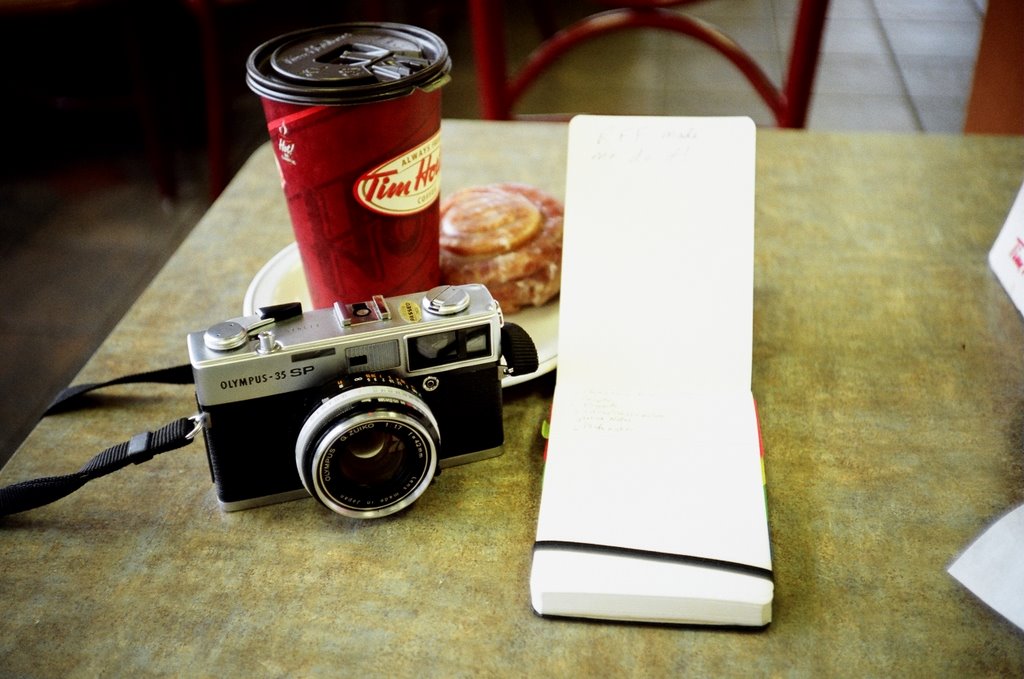
Or: How I Unwittingly Joined a Trend
My friend DOF has been waiting for this post, since he wants to do a send-up on Moleskine notebooks. Uh, thanks, I think. Actually, DOF had been kind enough, when I had emailed him about my first Moleskine acquisition, to point me to a few websites, including the Moleskinerie blog, which focuses on Moleskine "hacks". Even if I hadn't already become fond of my small reporter Moleskine, the very thought of the techno term "hack" in the context of such a retro, even anti-techy object such as the Moleskine made me smile, and cemented my affection.
As I visited the links that DOF had sent, and found more, I discovered that use of Moleskines was something of a phenomenon, with lots of web and blog attention. Like any trend that is noted on the web, there will be satire, send-ups and downright derision. I'm not a trendy person by nature, but if I am to be lumped into this group, so be it; I'll even enjoy the more humourous characterizations.
As I began to use the Moleskine, I found it a useful tool for organizing myself. A typical organizer such as Day Runner, TimeText (are they still around?), Day Timer and others has a specific structure that may or may not represent my needs, my way of thinking and working. Most of them tend to be bulky because the publisher tries to cram in every type organizing funciton they can.
Add to that they are usually ugly, made of cheap materials that are not a pleasure to use. While the market may be somewhat price competitive, the cheapness of the cover, closures and especially paper make them no bargain in my book.
So the most appealing aspect of a Moleskine is that it is available in a variety of sizes, formats, types of paper, and is a complete blank page (pun intended) unless you really want one of the purpose-made books such as a calendar or address book. It yours to design and build as you see fit.
And the materials are first rate. Oh, you can find a journal with a nicer cover or binding, maybe more luxurious paper, etc., although the paper used in a Moleskine is quite nice and a pleasure to the touch. But for the modest price (yes, you can buy cheaper blank books, but they are ... cheap), the combination of utility and tactility is just right for me.
My first Moleskine was the small-size reporter model; it has blank pages and the binding is at the top, so it flips open from the top. In fact, though, I didn't use it much as I contemplated just how I wanted to organize it.
Actually, the delay worked out well. One weekend in mid-July I was camping with my wife and two other families and I absent-mindedly left open the front windows and sunroof of my car. Yup, it poured that night. And poured. And then it rained some more. We were safe and dry in our tent, and it was actually a pleasant storm to experience. Only the next morning did I discover the cost of my failure to close up the vehicle. Everything dried out pretty well, but the Moleskine was a loss. It was swollen more than twice its size, and it was evident it would never recover enough to be used.
The only valuable content was the signatures of some Toronto area Rangefinderforum.com members. We had met in late June in Port Credit, and I had everyone sign. So I've saved that page and the page with the "RFF made me do it!" entry. RFF, and the Toronto members in particular, have meant a lot to me.
Once I replaced the reporter Moleskine, I read through the hacks on the web, and fairly quickly gained an idea of how I would modify my Moleskine to suit my own life. I ended up using Post-It tabs and flags to help divide it into sections. Then it was simply a matter of deciding what subjects or categories were both important and persistent. Once I determined those, the rest was easy.
Now it is a daily companion. Some days I use it a lot, others not at all. But it doesn't require batteries or start-up time. Paper is nicer to use than plastic and a glowing screen. And I seem to like using a pencil or gel pen better than a stylus. It is my Personal Analog Assistant.
Note: The lead photo was made using a Konica C35 with Auto-up (aka, closeup) adapter, on Eckerd (aka Fuji) 200 film, procssed and scanned by "my current" mini-lab to high-res TIFF. I have found drugstore mini-labs to give variable results with respect to processing and scanning. So I am now spending a bit more (actually, about 50% more) to get consistent quality from a stand-alone, independent lab. Once I get a scanner of my own, I'll be able to do my own scans and have the lab do develop-only.
Sunday, September 10, 2006
It was listed as a "lecture"
Images so powerful and compelling that the added intensity of sounds, poetry and music drives me to silence.
I wrote those notes after the first half of a multi-media presentation by Larry Towell, a Magnum photographer, and Mike Stevens. As part of the "Wish You Were Here" lecture series at George Eastman House, the format was certainly not lecture.
The first half presented images of The Mennonites, followed by photos of "the disappeareds" in Guatamala, then Palestine. All were accompanied by poetry and verse, bones and other percussion instruments all by Towell, and Stevens on harmonica and bell.
My gut was pulled out of me. The Mennonite photos were touching and moving, but the Guatemala photos were beyond moving. Near despair combined with rage are the only words that I can muster, and they are not adequate.
Thankfully, the second half was far different. Titled "The World from My Front Porch", the series of photos and songs composed by Towell document family life in and around his farm. Towell plays guitar and has a good voice, but as his accompanist apparently had remarked, only knows one key. And his melodies are all roughly similar, though pleasant. The songs are, to me, distinctly Canadian, being rooted in the land and with a rural flavour that is reminiscent of other Canadian songwriters of the folk genre.
My emotions were twisted and wrenched again, however. It all made me incredibly homesick, and my eyes welled up. I thanked him afteward for "making me cry", and we had a short chat about it.
Right now I am drained and affected. As one of his poems elucidated, Guatemalans died for cheap cotton dresses in North American stores.
I wrote those notes after the first half of a multi-media presentation by Larry Towell, a Magnum photographer, and Mike Stevens. As part of the "Wish You Were Here" lecture series at George Eastman House, the format was certainly not lecture.
The first half presented images of The Mennonites, followed by photos of "the disappeareds" in Guatamala, then Palestine. All were accompanied by poetry and verse, bones and other percussion instruments all by Towell, and Stevens on harmonica and bell.
My gut was pulled out of me. The Mennonite photos were touching and moving, but the Guatemala photos were beyond moving. Near despair combined with rage are the only words that I can muster, and they are not adequate.
Thankfully, the second half was far different. Titled "The World from My Front Porch", the series of photos and songs composed by Towell document family life in and around his farm. Towell plays guitar and has a good voice, but as his accompanist apparently had remarked, only knows one key. And his melodies are all roughly similar, though pleasant. The songs are, to me, distinctly Canadian, being rooted in the land and with a rural flavour that is reminiscent of other Canadian songwriters of the folk genre.
My emotions were twisted and wrenched again, however. It all made me incredibly homesick, and my eyes welled up. I thanked him afteward for "making me cry", and we had a short chat about it.
Right now I am drained and affected. As one of his poems elucidated, Guatemalans died for cheap cotton dresses in North American stores.
Wednesday, August 02, 2006
Time running out?
When the trees move north...
An article in the Toronto Star by Cameron Smith does an excellent job of both setting global warming into context and illuminating the complexities of environmental changes that occur when the ecosystem is disturbed.
Most people wouldn't think that an annual average temperature increase of, say, 1.2 deg Celsius is significant. But in environmental terms it IS significant. It reminds me of a co-op student who once worked with me. The big environmental topic of the time was destruction of the Amazon rain forest, and the impact on oxygen levels. Being a business student, Glen (I can't recall if that was actually his name), had done some research and discovered that the Amazon rainforest "only" contributed 6% of the the world's oxygen supply. From this he reasoned that even if all the Amazonian rainforest were destroyed, world oxygen levels would have minimal impact, and it could recover.
Well, it ain't that simple, Glen. Complexity is what escapes most of the global warming deniers. And W is the leader of that pack. Maybe his Crawford ranch will experience spontaneous combustion.
An article in the Toronto Star by Cameron Smith does an excellent job of both setting global warming into context and illuminating the complexities of environmental changes that occur when the ecosystem is disturbed.
Most people wouldn't think that an annual average temperature increase of, say, 1.2 deg Celsius is significant. But in environmental terms it IS significant. It reminds me of a co-op student who once worked with me. The big environmental topic of the time was destruction of the Amazon rain forest, and the impact on oxygen levels. Being a business student, Glen (I can't recall if that was actually his name), had done some research and discovered that the Amazon rainforest "only" contributed 6% of the the world's oxygen supply. From this he reasoned that even if all the Amazonian rainforest were destroyed, world oxygen levels would have minimal impact, and it could recover.
Well, it ain't that simple, Glen. Complexity is what escapes most of the global warming deniers. And W is the leader of that pack. Maybe his Crawford ranch will experience spontaneous combustion.
Monday, July 24, 2006
Using a hammer to drive a screw

Close-ups with a rangefinder
Fixed-lens rangefinder cameras aren't really made for macro or close-up work. Most, as is the case with my various Olympus RFs, have a lens in the normal range (40-55mm focal length) and their closest focus is about 1 meter. Compare that to a normal lens on a 35mm SLR which typically can focus down to about 1/2 meter, and there's a difference of an order of magnitude.
As I told one friend, "if it's hard to do I figured I should try". Another interpretation of that, of course is, "Sheesh, why not use an SLR ... you've only got SEVERAL ... not to mention bellows and lenses more suited to macro." Like I said...
Well, the results were pretty pleasing. A slower speed film would have been somewhat better, IMO, but Fuji NPH 400 Professional did really well.
How I did it...
I used an Olympus MCON 40, which is a macro/close-up lens intended for use on some of Olympus' digital cameras. I attached it to the 35 SP by using a 49-55 mm step-up ring; the 35 SP's diameter for threaded attachments is 49mm, and the MCON 40 has a 55mm filter thread.
With the camera empty of film and the MCON 40 mounted, I opened the back of the camera. I had cut a piece of frosted acetate into a 24x36mm rectangle (actually, a tiny bit larger), which served as a type of "ground glass" for focusing. The frosted side was mounted toward the lens, i.e. the smooth side facing the back of the camera.
Moving the shutter speed dial to the 'B' setting and the aperture to f1.7, the lens set at closest focus and in bright sunlight, I moved the camera forward and backward until an object came in sharp focus. Upon achieving focus, I measured the distance from the film plane to the object with a ruler.
The above procedure gave me the correct focus distance for this particular camera. It's not an easy process, but once determined, I can use the ruler to set camera/subject distance with this camera/close-up lens combination. This does not compensate for parallax, which is the phenomenon of the image not be centred in the lens' field of view because the rangefinder mechanism is off centre from the lens axis. (Parallax is only of concern at close focusing distances.) To compensate fo parallax, I simply approximate the offset by eyeballing it. To calculate the actual offset would require more exacting experiments, which I'm not really interested in doing.
Tuesday, July 11, 2006
The Nature of Scientific Work
My major in university was biology, with a minor in chemistry. Initially I had been interested in going on to medical school, but for various reasons decided against that. As it turns out, my various jobs and career development meant that while I never direclty worked in either field, training in the scientific method has always been a benefit. Through various stints in information technology areas, being able to create hypotheses, valid test plans and being able to analyze results has been an enormous advantage. For example, my current gig as a sales engineer supporting sales reps seeling Voice-over-IP (VoIP) systems requires that I quickly evaluate assumptions, proposed "solutions" (both as conceived by sales reps and prospective customers,) based on my company's system architecture and the true capabilities of network protocols, etc. (Note: Most of the time both sales reps and prospects are wrong.)
The nature of scientific rigor is that experimentation where variables are controlled are at the vary heart of fact-finding and the development of accepted scientific theory. Experiments, hypotheses and formulae are open to peer review, that is, repetition and testing by other parties.
All this seems very simple, yet it is subject to complexities in the "real world".
A vocal group who either deny global warming is a real phenomenon or who at the very least dismiss the human contribution to climate change invariably declare (normally in breathless, apoplectic language) that nothing is "proven", that there has been no definitive scientific proof of global warming as a trend attributable to human activity.
The problem with this, of course, is how do you conduct a controlled experiment with planet Earth as the subject? Since there is only one Earth available for observation, and we obviously cannot control all variables so as to change only one and observe the results, we can never "prove", to the satisfaction of those who deny global warming that it truly exists or is a human-influcenced/induced problem.
The proper response to this, of course, is that the question, while in the scientific realm, is not one that can be subjected to controlled observation and experimentation. In other words, it is a different, if not special, case of scientific study, just as there are special cases in all realms of study.
This is a long way of introducing a brilliant article by Showey Yazdanian, a Torontonian who is currently a PhD student at Cornell University. If I were like Bill O'Reilly and the other neo-con know-it-alls, I would tell them to "shut up". But I'm not, and I believe in open discussion, so recommend the article to you to provoke thoughtful dialogue.
No one can deny we only have one home .... one planet ... and that how we handle this issue is of enormous import.
The nature of scientific rigor is that experimentation where variables are controlled are at the vary heart of fact-finding and the development of accepted scientific theory. Experiments, hypotheses and formulae are open to peer review, that is, repetition and testing by other parties.
All this seems very simple, yet it is subject to complexities in the "real world".
A vocal group who either deny global warming is a real phenomenon or who at the very least dismiss the human contribution to climate change invariably declare (normally in breathless, apoplectic language) that nothing is "proven", that there has been no definitive scientific proof of global warming as a trend attributable to human activity.
The problem with this, of course, is how do you conduct a controlled experiment with planet Earth as the subject? Since there is only one Earth available for observation, and we obviously cannot control all variables so as to change only one and observe the results, we can never "prove", to the satisfaction of those who deny global warming that it truly exists or is a human-influcenced/induced problem.
The proper response to this, of course, is that the question, while in the scientific realm, is not one that can be subjected to controlled observation and experimentation. In other words, it is a different, if not special, case of scientific study, just as there are special cases in all realms of study.
This is a long way of introducing a brilliant article by Showey Yazdanian, a Torontonian who is currently a PhD student at Cornell University. If I were like Bill O'Reilly and the other neo-con know-it-alls, I would tell them to "shut up". But I'm not, and I believe in open discussion, so recommend the article to you to provoke thoughtful dialogue.
No one can deny we only have one home .... one planet ... and that how we handle this issue is of enormous import.
Wednesday, June 07, 2006
Breaking in Brikka
The previous entry gave a brief rundown of receiving the Brikka and running some "break-in" pots. It's pretty obvious that I was excited, but I did want to expand on getting familiar with it.
As I wrote earlier, the Bialetti Brikka 2-cup had to be ordered from Italy. It ordered May 22, was shipped May 29 and the first delivery attempt was June 4. Whoa, that's pretty fast for the actual delivery time. Not sure of the delay in actually shipping it out, but it's not of great concern.
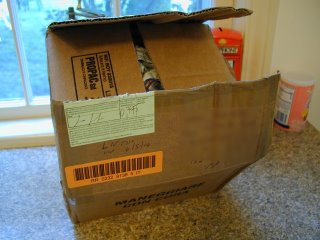
As I wrote earlier, the Bialetti Brikka 2-cup had to be ordered from Italy. It ordered May 22, was shipped May 29 and the first delivery attempt was June 4. Whoa, that's pretty fast for the actual delivery time. Not sure of the delay in actually shipping it out, but it's not of great concern.

The packaging was a cardboad box of medium strength and durability. You may be able to detect that the right side was somewhat crushed. It didn't affect the product, and I certainly understnad that being delivered through the postal system, gentle handling is not guaranteed.
No duty or taxes were assessed, which didn't particularly surprise me, but was certainly welcome.
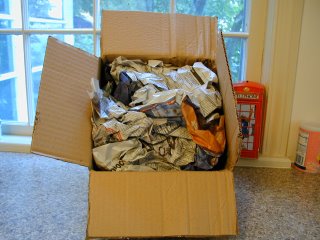
The packing material was crumpled newspaper. Since the Brikka itself was in its retail box, this proved to be adequate but not ideal. Given the rough handling in transit, newspaper for packing material didn't give much protection; the retail box had a tear in it, which may be the result of less than ideal packing material. Without a sturdy inner box, the Brikka itself might have been marred if not damaged.
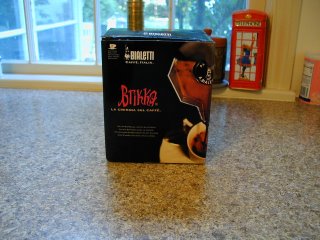
No duty or taxes were assessed, which didn't particularly surprise me, but was certainly welcome.

The packing material was crumpled newspaper. Since the Brikka itself was in its retail box, this proved to be adequate but not ideal. Given the rough handling in transit, newspaper for packing material didn't give much protection; the retail box had a tear in it, which may be the result of less than ideal packing material. Without a sturdy inner box, the Brikka itself might have been marred if not damaged.

You can't see the tear damage in this shot. But it is an attractive box. I'm storing it away for safekeeping; I don't throw out boxes for appliances.


The 2-cup Brikka is positively tiny. It's a little jewel, IMO. Next to the Turkish grinder, it looks so diminutive you wonder if the amount of café that can be made is worth the effort. More on that later.
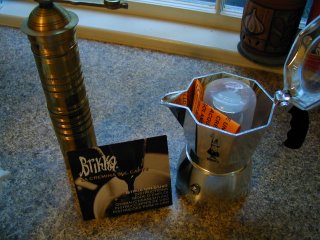
The instruction leaflet is packed in the box. Opening up the lid (note the lid has a window in it, something I was not expecting in the 2-cup version,) you find the water measuring cup, a notice tag and a very small quick guide to the use of the Brikka.
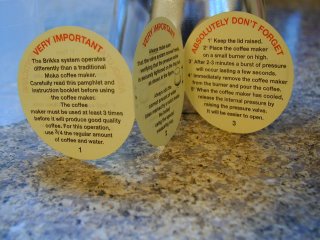
While this quick guide has a cute format, what caught my eye was under the "Absolutely Don't Forget" heading. Keep the lid open? That certainly isn't intuitive, but when you follow this guidline you see there isn't any danger of hot, black liquid shooting out and inflicting 2nd degree burns on your face. So this begs the question, why the window in the lid? Granted you need to close the lid when you pour the coffee, but at that point the see-through window doesn't seem to have much utility. Any ideas?

After pouring the correct amount of water into the boil pot, grinding some beans and loading them into the grounds filter, I screwed the receiving chamber onto the boil pot, placed the unit onto the stove and adjusted the flame to not extend beyond the circumferance of the pot. Now it was wait time. The instruction leaflet indicates prep time is 3-4 minutes. I didn't keep exact time, after all I was anxious plus focused on capturing creama production with the camera.

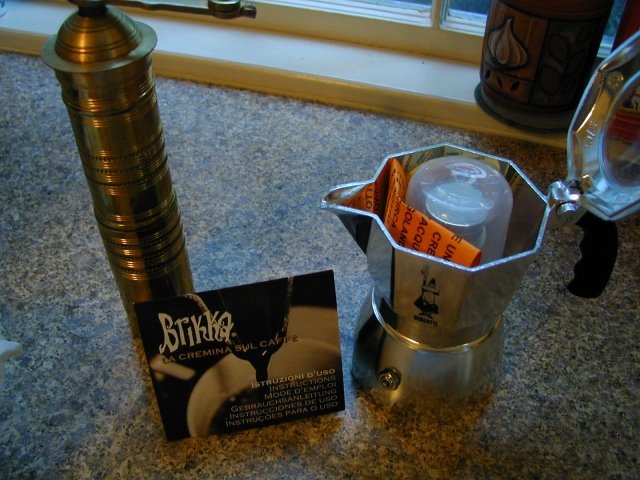
The instruction leaflet is packed in the box. Opening up the lid (note the lid has a window in it, something I was not expecting in the 2-cup version,) you find the water measuring cup, a notice tag and a very small quick guide to the use of the Brikka.
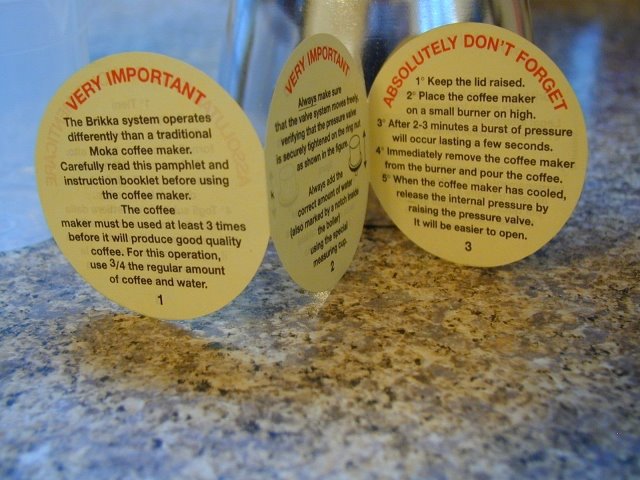
While this quick guide has a cute format, what caught my eye was under the "Absolutely Don't Forget" heading. Keep the lid open? That certainly isn't intuitive, but when you follow this guidline you see there isn't any danger of hot, black liquid shooting out and inflicting 2nd degree burns on your face. So this begs the question, why the window in the lid? Granted you need to close the lid when you pour the coffee, but at that point the see-through window doesn't seem to have much utility. Any ideas?
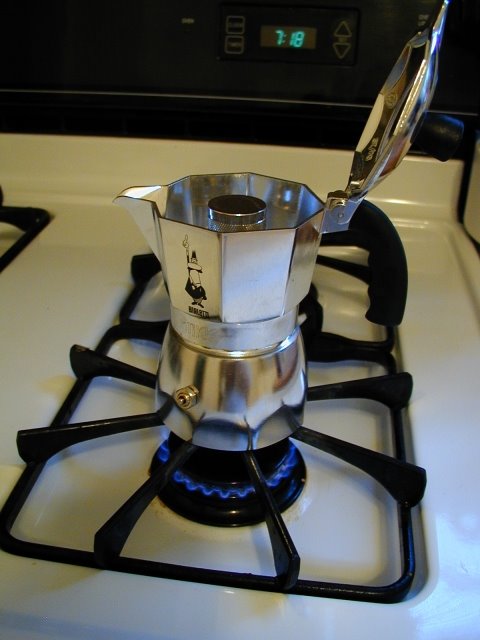
After pouring the correct amount of water into the boil pot, grinding some beans and loading them into the grounds filter, I screwed the receiving chamber onto the boil pot, placed the unit onto the stove and adjusted the flame to not extend beyond the circumferance of the pot. Now it was wait time. The instruction leaflet indicates prep time is 3-4 minutes. I didn't keep exact time, after all I was anxious plus focused on capturing creama production with the camera.
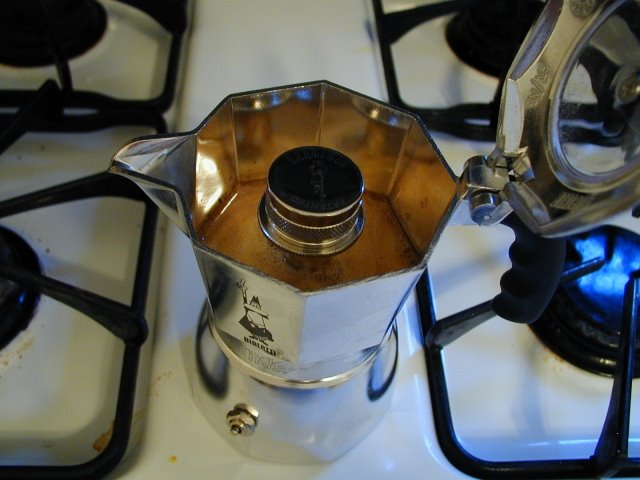
And there it is ... the "pre-produciton run" of Brikka coffee ... with crema indeed! Some comments online have stated that Brikka crema will dissipate quickly, especially if not poured immediately. I didn't notice the former, but the may dissipate quickly in the cup. I say may because I don't own any espresso cups, so poured into a normal-sized coffee cup. My theory is that enlarged surface area of the relatively large diameter of cup will hasten crema dissipation. OK, so there's something I didn't think of when buying the Brikka, grinder, etc.... you really do need proper cups!
The next two preps produced roughly the same results, so the Brikka is now officially prepared for full production. I've purchased some beans from Finger Lakes Coffee, and tomorrow morning will be the first "real" pot. Due to a recent kitchen reno, I couldn't find the sugar when I ran the condition runs, so even if I'd had good beans for that, any taste experience would have been less than optimal. Some people may take their espresso naked (I don't add anything to "regular" coffee), but not me!
The only drawback so far is that amount of cafe produced will be enough for one person. When I have guests, this will be a problem, since the pot has to cool down before you unscrew the two parts. If only the 4-cup model made crema as well as the 2-cupper. Oh well, such are the laws of physics; but so far the results justify the choice. If Santa were to bring me a 4-cup model, I certainly could compare results...
The only drawback so far is that amount of cafe produced will be enough for one person. When I have guests, this will be a problem, since the pot has to cool down before you unscrew the two parts. If only the 4-cup model made crema as well as the 2-cupper. Oh well, such are the laws of physics; but so far the results justify the choice. If Santa were to bring me a 4-cup model, I certainly could compare results...
Tuesday, June 06, 2006
We have crema!


My pot arrived today. Well, the postman rang once yesterday but no one was home, so I picked it up today. More film at 11, but it is a cute little unit! The photos show the first stage of crema production, then the at the end stage.
I had to run it at 3/4 capacity 3 times to "break it in", so I used whatever beans I had lying around, which were not espresso/Italian roast. It DOES produce crema, and the flavour is pretty good for break-in period and ordinary beans. I think I lucked out setting the grinder burrs correctly.
I'll post a follow-up with details and will include more photos. So far, a success!
Thursday, May 18, 2006
Coffee Unhappiness
Ruined by a Good Espresso Experience
Late last month I visited my best friend, who had purchased a quality burr coffee grinder and a home espresso machine. I have no idea what models they were. All I know is that it was a marvelous experience to have a superb capuccino in the morning or espresso at any time.
So now I am on a mission to transform my coffee-making at home. The Bodum French press I am using is OK, but I don't have the technique dialed in quite yet. But even more than that, I need to have fresh-roasted beans, grind them properly, and probably replace the Bodum, probably with a Chemex for "regular" coffee and to take to work in the Gott, and a pot to make moka. Bialetti is the name in what are called "moka pots". No, it's not espresso, but a true, high quality espresso machine is outside my means at this time. And despite its eccentricies, I would gravitate to La Pavoni, if for no other reason than its sheer beauty and its heritage. The "problem" with La Pavoni is that it is finicky. Using it is a real art, requiring training and practice. I would want hands-on mentoring, and finding that in my small city might be a challenge. And they're not cheap, though they're not the most costly either.
In addition, the Bialetti Brikka 2-cup, which is what I have decided to acquire, is not distributed into this country, so I am trying to find a vendor who can ship to me. The 2-cup is reported to be better than the 4-cup due to the volume of the boil pot, so I won't bother with the easily available 4-cup model. And the 2-cup is on indefinite backorder ... grrrrr. My goal is to have it in place by June 16, when the aforementioned best friend visits here, but it looks like the chances of that are slim.
So for now I will visit the local roasters and select a roaster that is reliable and quality-oriented; I'm planning on purchasing beans as often as twice a week to insure freshness. Eventually I will get a proper grinder, but there's some stick-handling with the household minister of finance to be done first.
Ciao, baby.
Late last month I visited my best friend, who had purchased a quality burr coffee grinder and a home espresso machine. I have no idea what models they were. All I know is that it was a marvelous experience to have a superb capuccino in the morning or espresso at any time.
So now I am on a mission to transform my coffee-making at home. The Bodum French press I am using is OK, but I don't have the technique dialed in quite yet. But even more than that, I need to have fresh-roasted beans, grind them properly, and probably replace the Bodum, probably with a Chemex for "regular" coffee and to take to work in the Gott, and a pot to make moka. Bialetti is the name in what are called "moka pots". No, it's not espresso, but a true, high quality espresso machine is outside my means at this time. And despite its eccentricies, I would gravitate to La Pavoni, if for no other reason than its sheer beauty and its heritage. The "problem" with La Pavoni is that it is finicky. Using it is a real art, requiring training and practice. I would want hands-on mentoring, and finding that in my small city might be a challenge. And they're not cheap, though they're not the most costly either.
In addition, the Bialetti Brikka 2-cup, which is what I have decided to acquire, is not distributed into this country, so I am trying to find a vendor who can ship to me. The 2-cup is reported to be better than the 4-cup due to the volume of the boil pot, so I won't bother with the easily available 4-cup model. And the 2-cup is on indefinite backorder ... grrrrr. My goal is to have it in place by June 16, when the aforementioned best friend visits here, but it looks like the chances of that are slim.
So for now I will visit the local roasters and select a roaster that is reliable and quality-oriented; I'm planning on purchasing beans as often as twice a week to insure freshness. Eventually I will get a proper grinder, but there's some stick-handling with the household minister of finance to be done first.
Ciao, baby.
Sunday, May 14, 2006
Six Years In
After six years of Shrub's absolutely brialliant reign his "wooden" opponent of the 2000 election is looking not only better, (as I always knew him to be) but a helluva lot funnier.
The world is now less secure, the middle east is more fragile, North America is no less dependent on fossil fuel, global warming as a result of fossil fuel dependence, is not only becoming more evident but also more intractable due to the Bush administration's ostrich strategy. The debt load for future generations increases minute-by-minute, political discourse is no longer true discourse, and the politics of sleaze and corruption rules. Thanks a lot fundamentalist right wing. We will not allow you to prevail.
The world is now less secure, the middle east is more fragile, North America is no less dependent on fossil fuel, global warming as a result of fossil fuel dependence, is not only becoming more evident but also more intractable due to the Bush administration's ostrich strategy. The debt load for future generations increases minute-by-minute, political discourse is no longer true discourse, and the politics of sleaze and corruption rules. Thanks a lot fundamentalist right wing. We will not allow you to prevail.
Wednesday, April 12, 2006
GOTT it?
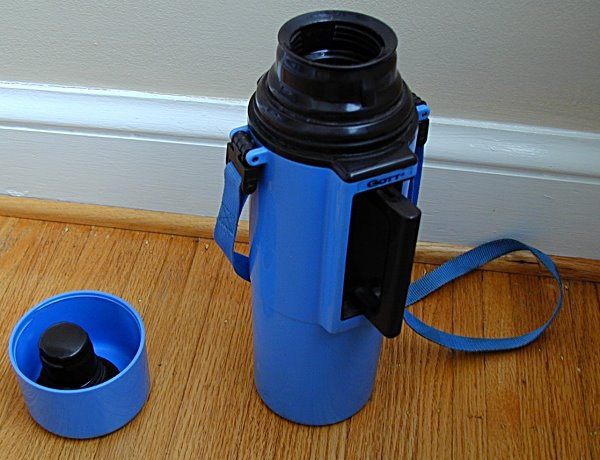
Due to a power failure at my place of work Friday 3/31, deskside appliances such as my little coffee maker were banned. After considering several options, I decided to simply make coffee at home in the morning and fill a Gott vacuum bottle which I had purchased back in oh, the mid 1980s. I hadn't used it in years, and had to retrieve it from the garage, clean it up, etc.
So Monday morning I make the coffee, fill the Gott, and put it near the front door by my briefcase. Naturally, I don't "see" it when I leave, lending yet more empirical evidence to the understanding that we see with our brains, not our eyes.
So Tuesday morning comes along, and I check the Gott to asses the temperature of the coffee. As I open the stopper, there is a "tshish" as a vacuum is broken, and steam (OK, water vapour) escapes. Hallelujah! I take a sip, and no, it's not truly that hot, but it would be drinkable by some people (such as my wife) who don't like their hot beverages actually hot. So I take it to work and simply nuke my coffee cup when I need to.
Now will someone please tell me why Rubbermaid, who purchased Gott many years ago, discontinued this vacuum bottle? There are still Gott-branded products such as water coolers, etc. But these excellent bottles seem to have been killed off by Rubbermaid. Last year I saw a smaller one at an estate sale and bought it for 50 cents. I haven't used it yet, but whenever I see a Gott I want to buy it. My recent re-introduction to the Gott's tremendous insulating properties "force" me to act on that desire.
Tuesday, March 21, 2006
Thursday, March 16, 2006
Scans re-Redux


A Re-do and Some Adjustments
Since I don't have enough experience with scanning chromes I wasn't sure, in light of my disappointment with a "professional" lab's job of scanning some Kodachrome and Elitechrome slides, how high my expectations should be. So I finally took my lunch hour one day and visited a firm that specializes in digital processing and printing. I spent about 15 minutes with the technician, explaining that I just wanted my expectations to be set properly both with initial scan quality and what could be done in post-processing.
What I learned was that I should expect more/better, and that some post-processing adjustments are pretty easy. The latter I picked up from simply observing how he manipulted the that images we opened up; it was like a free mini-lesson in Photoshop.
So at home I practiced some post-processing adjustment and came up with the results posted here.
Since I don't have enough experience with scanning chromes I wasn't sure, in light of my disappointment with a "professional" lab's job of scanning some Kodachrome and Elitechrome slides, how high my expectations should be. So I finally took my lunch hour one day and visited a firm that specializes in digital processing and printing. I spent about 15 minutes with the technician, explaining that I just wanted my expectations to be set properly both with initial scan quality and what could be done in post-processing.
What I learned was that I should expect more/better, and that some post-processing adjustments are pretty easy. The latter I picked up from simply observing how he manipulted the that images we opened up; it was like a free mini-lesson in Photoshop.
So at home I practiced some post-processing adjustment and came up with the results posted here.
Sunday, March 05, 2006
Atget at George Eastman House
Atget & Rauschenberg
I don't know if this exhibit will travel anywhere other than the International Center of Photography, but if it does come to a space near you, you should see it.
I saw it for the first time at GEH yesterday, and will return next week, and likely again. This is not because the exhibit is so absorbing or brilliant. It is wonderful, especially as GEH plays classicly Parisian music in the exhibit hall and that creates a wonderful atmosphere that is, for me, transporting.
Rather, I will return because I cannot seem to absorb such an exhibit in one visit. I have observed this each time I have been to GEH. Sometimes the presentation and lighting have been irritating (the recent Weston exhibit was disappointing in some respects), but as a lover of photographs, I can't seem to truly appreciate exhibits, especially large ones in just one visit. It is just too much visual information to process.
Rauschenberg's photos are very well seen and executed. Working to a very high level of craft with modern 35mm materials, each photo is visually precise and evocative.
But the Atget prints ... well, they transported me. Ignoring the 70-80 years of change in Paris between the Atget and Rauschenberg photos, Atget's choice of materials were brilliant. I have never before seen albumen prints, I don't think. Even in Atget's time, wet plates and albumen printing were "outdated", but he refused to use more modern materials. That was a brilliant choice. The long exposure times necessary for the wet plates dictated much of Atget's choices, and the nature of those negatives combined with the tonal scale of albumen makes Atget's Paris glow. Given that much of Atget's intent seemed to preserve a Paris that he saw as passing all too quickly, how fortunate he not only chose as he did, but that the images survive to convey not only the Paris of the period, but the atmosphere, the feeling of a great city emerging as well as passing by.
Yesterday there was to be an exhibit tour conducted in French. Sadly, no one knew anything about the tour, and the tour guide never showed. I was really disappointed; being around French in this town is almost non-existant. But the music and exhibit itself made it all better, and there are tours in French scheduled for additional Saturdays, so I will call tomorrow to make sure it was just a one-time mix-up.
Atget links:
http://www.photo-seminars.com/Fame/eugene.htm
http://www.eastman.org/fm/atget/htmlsrc/INDEX.HTML
I don't know if this exhibit will travel anywhere other than the International Center of Photography, but if it does come to a space near you, you should see it.
I saw it for the first time at GEH yesterday, and will return next week, and likely again. This is not because the exhibit is so absorbing or brilliant. It is wonderful, especially as GEH plays classicly Parisian music in the exhibit hall and that creates a wonderful atmosphere that is, for me, transporting.
Rather, I will return because I cannot seem to absorb such an exhibit in one visit. I have observed this each time I have been to GEH. Sometimes the presentation and lighting have been irritating (the recent Weston exhibit was disappointing in some respects), but as a lover of photographs, I can't seem to truly appreciate exhibits, especially large ones in just one visit. It is just too much visual information to process.
Rauschenberg's photos are very well seen and executed. Working to a very high level of craft with modern 35mm materials, each photo is visually precise and evocative.
But the Atget prints ... well, they transported me. Ignoring the 70-80 years of change in Paris between the Atget and Rauschenberg photos, Atget's choice of materials were brilliant. I have never before seen albumen prints, I don't think. Even in Atget's time, wet plates and albumen printing were "outdated", but he refused to use more modern materials. That was a brilliant choice. The long exposure times necessary for the wet plates dictated much of Atget's choices, and the nature of those negatives combined with the tonal scale of albumen makes Atget's Paris glow. Given that much of Atget's intent seemed to preserve a Paris that he saw as passing all too quickly, how fortunate he not only chose as he did, but that the images survive to convey not only the Paris of the period, but the atmosphere, the feeling of a great city emerging as well as passing by.
Yesterday there was to be an exhibit tour conducted in French. Sadly, no one knew anything about the tour, and the tour guide never showed. I was really disappointed; being around French in this town is almost non-existant. But the music and exhibit itself made it all better, and there are tours in French scheduled for additional Saturdays, so I will call tomorrow to make sure it was just a one-time mix-up.
Atget links:
http://www.photo-seminars.com/Fame/eugene.htm
http://www.eastman.org/fm/atget/htmlsrc/INDEX.HTML
Sunday, February 26, 2006
Tower 51 Cleans up its Act
Cleaning the Tower 51 Viewfinder
Yesterday evening I disassembled the top plate of the Tower 51. As I referenced in an earlier post, the viewfinder of this camera was pretty dirty ... well, filthy is a better word ... so I finally got around to it. Cleaning all the glass surfaces took some time, plus when I removed the accessory shoe (which wasn't really necessary) the assembly that held the RF and VF window glass fell out. The glass elements had to be thoroughly cleaned and re-glued to the bracket (I used epoxy), and reassembling the whole lot caused some frustration until I figured out the order.
I had taken macro shots of the process with my digicam, so getting all the top pieces back together this morning was pretty easy, but the advance assembly caused me some problems, and I had to put everything together twice. It's functional, but not Leica buttery-smooth. Hell, it's not even as smooth as the Olympus 35 SPs.
BUT, the view of the world is so much better now. While the viewfinder is not nearly as bright as the best RFs, it is surprisingly easy to focus. It gives a 1:1 view, I think, and aligning the rangefinder patch is positive.
Since this is a meterless camera, I figured it's perfect for shooting in really dim light, with Kodak Tri-X pushed to E.I. 12,800, as per merciful's post over on RFF. Yikes, that looks yummy! Don't expect results from my foray into that world soon ... I don't process often, and right now stripping wallpaper in the kitchen is my main occupation.
EDIT: I worked on the film advance some more, and it's better. Still rough, and it takes two strokes to full advance and cock the shutter. Not sure what's wrong, but it's functional.
Sunday, February 19, 2006
Sunday morning coffee

The morning was sunny and bright, so I headed to Tim's with the Saturday Toronto Star for coffee, muffin and a leisurely read before diving into painting and stripping of wallpaper.
Finally some weather fit for slow film, so I had loaded up the SP with Ilford Pan F+, which will be processed in Rodinal at 1:100. I want to establish a workflow for a slow film (ASA 50) such as Pan F+ to take advantage of its ability to render a long tonal scale, but maintain contrast. I am rating the film at ASA 40 to ensure shadow detail is retained.
Yeah, I realize it's now "ISO", not ASA. but I'm old enough to cling to the past and be curmudgeonly as well.
Alas, work at home called, so no shooting today.
Saturday, February 11, 2006
The Muslim cartoon flap
Over on Decrepit Old Fool, I commented on DOF's "Eat My Shorts" entry regarding the fallout from the publishing and republishing of the cartoon in a Danish and other papers. Some good points are made by DOF, who is a friend of mine. In fact, he's such a good friend that I can tell him to "eat my shorts" when I disagree with him, and we laugh together. DOF is a gun-totin', meat eatin' libertarian (well, I guess he owns a gun, I know he certainly isn't very enamored of gun control,) but he is a smart dude. He's sometimes wrong about stuff that that I'm always right about :) but then, I could be wrong about that.
Anyway, GUYK posted a reply which I think is a reply to my comments, so I've asked for some clarification from him. We'll see if he answers, but from just glancing at his blog, I don't think we'll see eye-to-eye on a lot.
Anyway, GUYK posted a reply which I think is a reply to my comments, so I've asked for some clarification from him. We'll see if he answers, but from just glancing at his blog, I don't think we'll see eye-to-eye on a lot.
Wednesday, January 25, 2006
Tower 51
Back in October I bought a Tower 51, a 35mm rangefinder camera sold through Sears in 1954. Sears didn't make any cameras, but had various manufacturers, such as Nicca, Olympus, Mamiya, etc. supplied cameras that were branded "Tower". The Tower 51 was made by Iloca, a German manufacturer. Supposedly the Tower 51 was a re-badging of the Iloca Rapid B, which is also referenced on Karen Nakamura's wonderful site. But my Tower 51 does not have the film advance on the left, as with the Rapid B, rather it is in the "normal" spot, on the right. Matt Denton's Tower 51 is the left-handed version, so there were at least two versions of the Tower 51.
This camera arrived in pretty good condition except that the viewfinder is very dirty. And the film advance feels so rough that I couldn't be sure the film was advancing properly. I threw a roll of Kodak B&W C41 (black and white film but processed in the same chemistry as colour negative film) just to test it. It took me quite a while to get the film developed and scanned to CD, and I wasn't too hopeful.
But, Shazaam! the results were quite good! As a meterless camera, I had to either use an external meter or choose my exposure by the "Sunny 16" rule. Next step is to do a CLA myself. I'm not going to send it out for a cost of $50-80, as I only paid $10 plus shipping. If I screw it up, I'm not out much, but I DO love the lens, a Steinheil Cassar 50mm/f2.8 which seems to be wicked sharp.
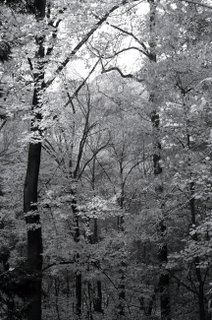
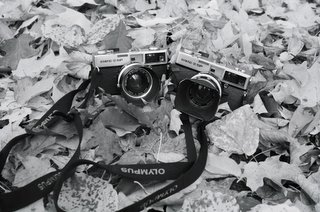
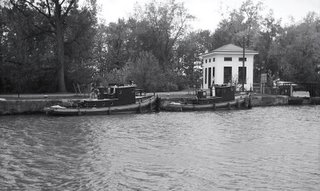
For Miss K: Here is a shot of the advance mechanism under the top plate. I have more photos of the disassembly procedure. Let me know if you want me to send them to you.

This camera arrived in pretty good condition except that the viewfinder is very dirty. And the film advance feels so rough that I couldn't be sure the film was advancing properly. I threw a roll of Kodak B&W C41 (black and white film but processed in the same chemistry as colour negative film) just to test it. It took me quite a while to get the film developed and scanned to CD, and I wasn't too hopeful.
But, Shazaam! the results were quite good! As a meterless camera, I had to either use an external meter or choose my exposure by the "Sunny 16" rule. Next step is to do a CLA myself. I'm not going to send it out for a cost of $50-80, as I only paid $10 plus shipping. If I screw it up, I'm not out much, but I DO love the lens, a Steinheil Cassar 50mm/f2.8 which seems to be wicked sharp.
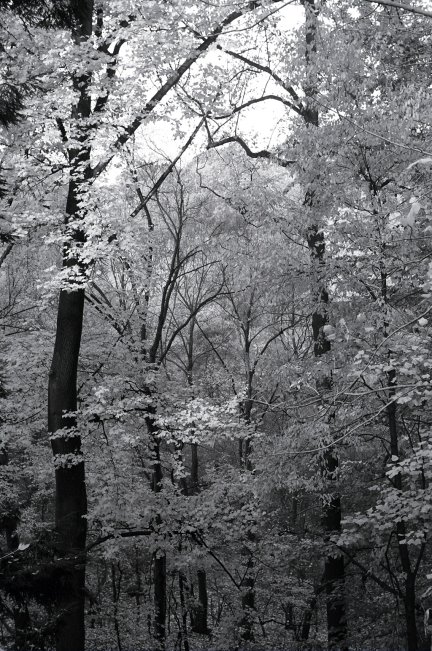
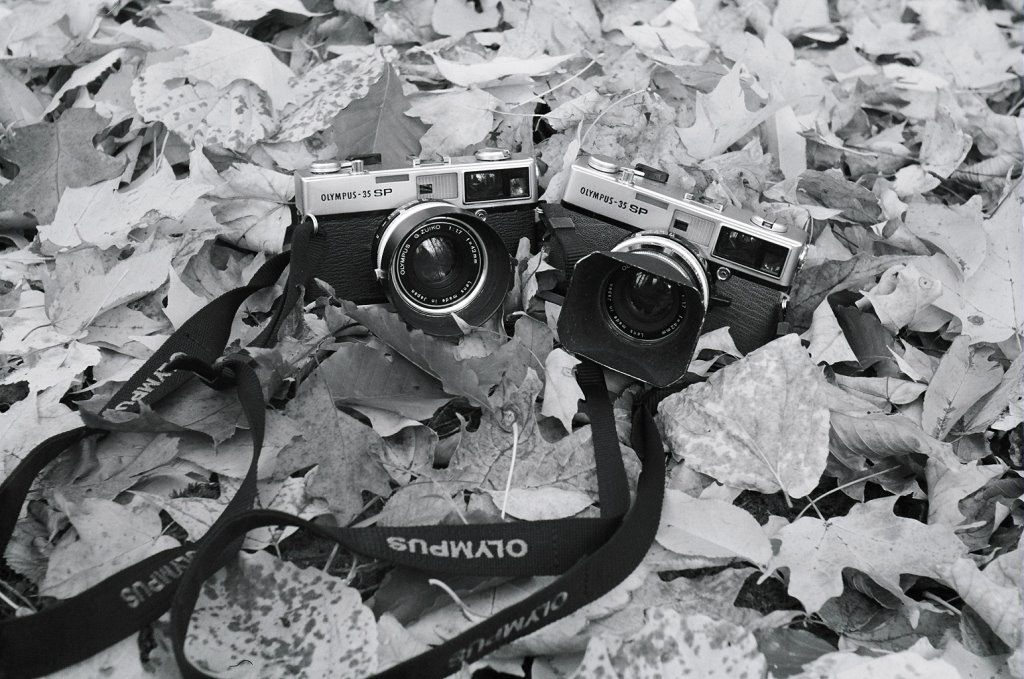
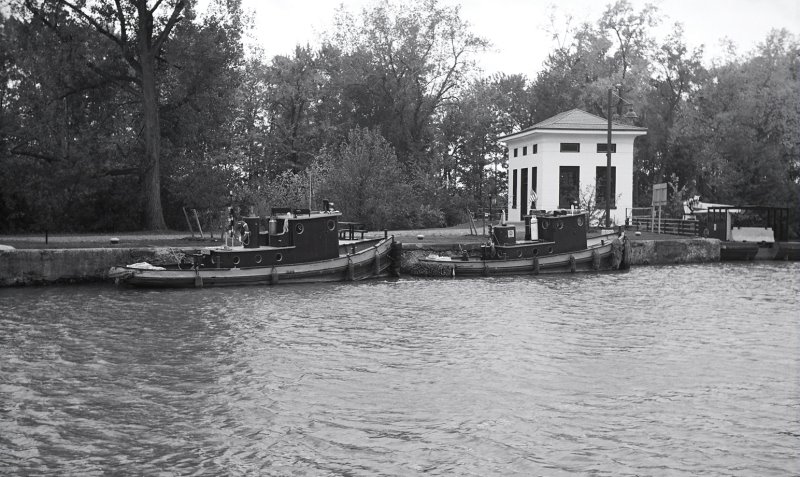
For Miss K: Here is a shot of the advance mechanism under the top plate. I have more photos of the disassembly procedure. Let me know if you want me to send them to you.

Friday, January 20, 2006
Scans Redux
Yesterday I picked up the rework of the scans I mentioned what, 5 weeks ago? Seems longer, so with the holidays I guess I shouldn't be too judgmental.
I'll post some JPGs here later; the results are better, but not totally satisfying. Sharpness is a lot better, for the most part, but dynamic range hasn't been retained. One of the contributors to the APUG forum is a photographic engineer and used to work for a major photographic manufactuer here where I live. I asked him if he knew of a better local source for scans. He hasn't been happy either, so bought his own scanner. I'll end up doing the same, but given my "standards" (does that sound self-absorbed?), it won't be cheap. So I'll need to wait until the wallet recovers from the HDTV purchase.
I'll post some JPGs here later; the results are better, but not totally satisfying. Sharpness is a lot better, for the most part, but dynamic range hasn't been retained. One of the contributors to the APUG forum is a photographic engineer and used to work for a major photographic manufactuer here where I live. I asked him if he knew of a better local source for scans. He hasn't been happy either, so bought his own scanner. I'll end up doing the same, but given my "standards" (does that sound self-absorbed?), it won't be cheap. So I'll need to wait until the wallet recovers from the HDTV purchase.
Tuesday, January 17, 2006
Thoughts on Digital Photography from a Film Luddite
I recently exchanged an email with my good friend Decrepitoldfool (aka DOF) regarding the state of analog/film cameras in the past year. I forwarded some thoughts by Tom Abrahamsson on the year past, in which he celebrated the release of many new lenses for rangefinder cameras, and the release of new RF bodies from Cosina and none other than Zeiss, the new Zeiss Ikon using the Leica M mount.
DOF replied that he was working on a blog entry on film vs. digital from a broader perspective. This prompted me to put together some of my thoughts in reply. Partly I was simply expressing myself as thoughts flowed, and partly I was happy to give DOF food for thought.
So, here is what I wrote. I'm not trying to steal his thunder, and I don't want to spark a film vs. digital debate. If anything, I see the advantages of digital being thwarted by inferior industrial design. OK, it's not just inferior, it's just plain stupid and idiotic.
Look at what Perez said about film and current digital cameras; he envisions image capture in glasses, jewelry, anything wearable. Huh? Technically achievable, but apart from spies, what consumers really want it? Most consumers can't operate the arcane digital interfaces that Kodak and others are giving them. 80-90% of a camera's capability are wrapped in a shround of menu/symbol mystery. Just when the interface is understood, a totally new generation/paradigm comes along. And... How will you frame image in your engagement-ring-cam?
What drove photography both as a hobby and as a profession was the stability of the controls interface that dovetailed with advances in lenses (the camera itself advanced only insigificantly) and film technology. I could pick up my OM-1 and transfer the knowledge of its control to an older Asahiflex IIa (pre Pentax/Spotmatic) or to a newer OM-2 or OM-4. Or a Leica, etc.
Now if I own a Kodak digicam and switch to a Fuji, Canon, Olympus, etc., it is much harder to re-learn the interface. Not impossible, but relatively fewer will do so than with film, and the remainder will use their cameras less. Given that the consumer digicam industry is built on product churn and repurchasing relatively frequently (the upward trend in total sales can't continue forever), this is a stupid thing. When equipment sales plateau, consumable revenue becomes even more important. Can the manufacturers entice users to regularly consume paper and ink to print their own images? I'm not so sure the current state of printing technology is acceptable, both in terms of ease of production and cost. My lord, I'd much rather have casual snaps printed at the corner grocery store on good quality Fuji or Kodak materials.
Cameraphones are "the thing" right now, but I haven't quite figured out how the component manufacturers can make good money with them. The real revenue goes to to the wireless service providers. If Zeiss provides lenses for a Nokia cameraphone, does Zeiss get a percentage on every image transmitted? Does Kodak get a cut on each transmission by virtue of supplying the sensor in a Motorola phone?
Interesting times, but my Olympus 35 SPs have a spotmeter and my head can do matrix metering calculations. Betcha I can't get that in a cameraphone.
Another problem is that photofinishers have been moribund in providing good service and being innovative. I'd post some ideas here, but they might actually make sense and be valuable. Hmmm.
DOF replied that he was working on a blog entry on film vs. digital from a broader perspective. This prompted me to put together some of my thoughts in reply. Partly I was simply expressing myself as thoughts flowed, and partly I was happy to give DOF food for thought.
So, here is what I wrote. I'm not trying to steal his thunder, and I don't want to spark a film vs. digital debate. If anything, I see the advantages of digital being thwarted by inferior industrial design. OK, it's not just inferior, it's just plain stupid and idiotic.
Look at what Perez said about film and current digital cameras; he envisions image capture in glasses, jewelry, anything wearable. Huh? Technically achievable, but apart from spies, what consumers really want it? Most consumers can't operate the arcane digital interfaces that Kodak and others are giving them. 80-90% of a camera's capability are wrapped in a shround of menu/symbol mystery. Just when the interface is understood, a totally new generation/paradigm comes along. And... How will you frame image in your engagement-ring-cam?
What drove photography both as a hobby and as a profession was the stability of the controls interface that dovetailed with advances in lenses (the camera itself advanced only insigificantly) and film technology. I could pick up my OM-1 and transfer the knowledge of its control to an older Asahiflex IIa (pre Pentax/Spotmatic) or to a newer OM-2 or OM-4. Or a Leica, etc.
Now if I own a Kodak digicam and switch to a Fuji, Canon, Olympus, etc., it is much harder to re-learn the interface. Not impossible, but relatively fewer will do so than with film, and the remainder will use their cameras less. Given that the consumer digicam industry is built on product churn and repurchasing relatively frequently (the upward trend in total sales can't continue forever), this is a stupid thing. When equipment sales plateau, consumable revenue becomes even more important. Can the manufacturers entice users to regularly consume paper and ink to print their own images? I'm not so sure the current state of printing technology is acceptable, both in terms of ease of production and cost. My lord, I'd much rather have casual snaps printed at the corner grocery store on good quality Fuji or Kodak materials.
Cameraphones are "the thing" right now, but I haven't quite figured out how the component manufacturers can make good money with them. The real revenue goes to to the wireless service providers. If Zeiss provides lenses for a Nokia cameraphone, does Zeiss get a percentage on every image transmitted? Does Kodak get a cut on each transmission by virtue of supplying the sensor in a Motorola phone?
Interesting times, but my Olympus 35 SPs have a spotmeter and my head can do matrix metering calculations. Betcha I can't get that in a cameraphone.
Another problem is that photofinishers have been moribund in providing good service and being innovative. I'd post some ideas here, but they might actually make sense and be valuable. Hmmm.
Monday, January 16, 2006
Recreating a Room
A move (local only) is in the near future, so getting the house de-cluttered (Lord, where DID all the stuff come from?), painted and repaired is absolutely necessary. This weekend the living room got painted and a lot of unnecessary shit was either tossed or boxed up. New paint (from a pale blue to Glidden's "Water Chestnut") went on the walls, and all the furniture was totally rearranged so that the room was "opened up". The new TV was installed on a coffee table and placed into a corner, with the components on the shelf below. Looks cool.
So, what about the TV? I'm happy. The only problems I had were:
1. It appeared that the component inputs weren't working.
2. I tried to get ahold of Syntax support to no avail. Their technical support call queue kicks you out after a very few minutes, forcing you to select an option from the IVR. If you go to the operator, you're often as not on hold and then have to back to the IVR for another ineffectual selection.
Of course, it didn't occur to me that I was calling during CES, the holy grail of trade shows for a company in this market. Once I realized this, I sort of understood what was going on, BUT the operator (once I got ahold of her) could have explained.
Email didn't work very well either, and I resorted to multiple email submissions and then emailing the PR contact at the parent company, which I found via a company press release.
Bottom line, I got the problem resolved, but it took far too long. Minus for customer service.
As far as performance goes, however, I am very happy. Image quality is very good, with the factory defaults being quite good. Yes, I've tweaked it a bit, but all the settings are easy to get to via the menu system. I do not have any high def content yet (another story), but SD images are not bad for an LCD/fixed pitch display which has to convert.
The most surprising discovery is the audio performance. I don't expect very good sound on a TV. No, it's not true HiFi, but it's actually quite good for a TV monitor. There are quite a few effect settings, most of which (all but one) are hokey, but with no EQ setting or on "pop", sound quality is better than average by far ... at least in my experience. The audio out is fixed, meaning you need to control volume via whatever amp/receiver it is feeding. It makes sense, but since I can't program my satellite receiver remote to control our current receiver, it's a PITA having to have 3 remotes.
I hope to have HD content by Saturday evening for HNIC. That's when I'll be able to better judge video performance, especially how it handles motion. The set has "Super in Plane Switching" (Super IPS) to minimize smear of fast-moving images such as a puck on the ice.
All-in-all, so far I can recommend this set. Time will tell regarding reliability, but the build quality seems very high, on a par with major brand names.
So, what about the TV? I'm happy. The only problems I had were:
1. It appeared that the component inputs weren't working.
2. I tried to get ahold of Syntax support to no avail. Their technical support call queue kicks you out after a very few minutes, forcing you to select an option from the IVR. If you go to the operator, you're often as not on hold and then have to back to the IVR for another ineffectual selection.
Of course, it didn't occur to me that I was calling during CES, the holy grail of trade shows for a company in this market. Once I realized this, I sort of understood what was going on, BUT the operator (once I got ahold of her) could have explained.
Email didn't work very well either, and I resorted to multiple email submissions and then emailing the PR contact at the parent company, which I found via a company press release.
Bottom line, I got the problem resolved, but it took far too long. Minus for customer service.
As far as performance goes, however, I am very happy. Image quality is very good, with the factory defaults being quite good. Yes, I've tweaked it a bit, but all the settings are easy to get to via the menu system. I do not have any high def content yet (another story), but SD images are not bad for an LCD/fixed pitch display which has to convert.
The most surprising discovery is the audio performance. I don't expect very good sound on a TV. No, it's not true HiFi, but it's actually quite good for a TV monitor. There are quite a few effect settings, most of which (all but one) are hokey, but with no EQ setting or on "pop", sound quality is better than average by far ... at least in my experience. The audio out is fixed, meaning you need to control volume via whatever amp/receiver it is feeding. It makes sense, but since I can't program my satellite receiver remote to control our current receiver, it's a PITA having to have 3 remotes.
I hope to have HD content by Saturday evening for HNIC. That's when I'll be able to better judge video performance, especially how it handles motion. The set has "Super in Plane Switching" (Super IPS) to minimize smear of fast-moving images such as a puck on the ice.
All-in-all, so far I can recommend this set. Time will tell regarding reliability, but the build quality seems very high, on a par with major brand names.
Saturday, January 07, 2006
New TV
I've been lusting after an HDTV for a couple of years now. I'd been living with a Sony 27" stereo dinosaur since about 1996. It was pretty spiffy at the time, having S Video input, and in 2001 I bought a JVC SVHS tape deck to compliment it and the satellite receiver which had S-video output.
Everything was was fine until I got married and we made the decision to use live in her house and sell mine. The layout of the living room is long and narrow, with a fireplace at one end and the main entrance at the other. So the only place to put the TV is along a long wall, with a sofa against the opposite wall.
The result is a crowded room if you have a coffee table in front of the couch. That 27" TV isn't big by today's standards, but a CRT set is deep, so the footprint isn't really good for a smaller room.
The solution? Flat screen of course! I used this argument on my wife for a long time ... "It will save space!" I repeated over and over. Plus, I had upgraded my satellite receiver to a High Def model, largely because the slightly larger dish that came with it meant I might improve my signal strength.
I have been watching reviews and comments on the Olevia brand of LCD TVs from Syntax Groups for almost two years. An "off" brand, it was cheaper by a wide margin that competing brands with similar specs. But I was wary, of course. And even the lower price point was still too for quite some time.
On Christmas day, however, I saw that the LT32HVE model was on sale on radioshack.com and had a $300 rebate. I was wary of having something this expensive shipped to my house. Obviously I'd want to be there to receive it, but arranging that would be something of a hassle. So I waited to the next day and went to a local Radio Shack to see if they had stock. They don't stock TVs that large, but they did say I could have it shipped there as long as I picked it up promptly, as they had limited storage.
So I went home and ordered it. A 10% off offer was no longer available :( but it was still a good deal.
It arrived on the January 3. Today I received a DVI cable to use as the connection from the receiver and the picture is closer to optimal than with S-video. But I don't have high def programming downloaded to the receiver yet (another story), so I can't really give a valid review. Once I get that sorted, I'll post some comments. One thing I have noticed is that the control of colour temp is very good. Watching HDIC right now, the flesh tones are right on, reds are not over saturated; the balance is very good.
Everything was was fine until I got married and we made the decision to use live in her house and sell mine. The layout of the living room is long and narrow, with a fireplace at one end and the main entrance at the other. So the only place to put the TV is along a long wall, with a sofa against the opposite wall.
The result is a crowded room if you have a coffee table in front of the couch. That 27" TV isn't big by today's standards, but a CRT set is deep, so the footprint isn't really good for a smaller room.
The solution? Flat screen of course! I used this argument on my wife for a long time ... "It will save space!" I repeated over and over. Plus, I had upgraded my satellite receiver to a High Def model, largely because the slightly larger dish that came with it meant I might improve my signal strength.
I have been watching reviews and comments on the Olevia brand of LCD TVs from Syntax Groups for almost two years. An "off" brand, it was cheaper by a wide margin that competing brands with similar specs. But I was wary, of course. And even the lower price point was still too for quite some time.
On Christmas day, however, I saw that the LT32HVE model was on sale on radioshack.com and had a $300 rebate. I was wary of having something this expensive shipped to my house. Obviously I'd want to be there to receive it, but arranging that would be something of a hassle. So I waited to the next day and went to a local Radio Shack to see if they had stock. They don't stock TVs that large, but they did say I could have it shipped there as long as I picked it up promptly, as they had limited storage.
So I went home and ordered it. A 10% off offer was no longer available :( but it was still a good deal.
It arrived on the January 3. Today I received a DVI cable to use as the connection from the receiver and the picture is closer to optimal than with S-video. But I don't have high def programming downloaded to the receiver yet (another story), so I can't really give a valid review. Once I get that sorted, I'll post some comments. One thing I have noticed is that the control of colour temp is very good. Watching HDIC right now, the flesh tones are right on, reds are not over saturated; the balance is very good.
Friday, January 06, 2006
Hockey Day in Canada (HDIC)
One of my other passions is hockey. The Stanley Cup is the epitome of a championship ... four rounds, 7 games each round, at the end of a grueling 82-game regular schedule. Men play hurt, come up huge, skate on pure grit and adrenalin.
But the real story of hockey is not just the NHL, the AHL, or other pro leagues. It is the Junior teams and those "below". A couple of years ago, driving along highway 18 in January in western New York, I passed a bunch of kids playing pond hockey in a farmer's field. Classic across Canada, more rare in the US. It was a magical moment for me, just seeing those kids out there having pure fun.
On January 7th, CBC will broadcast Hockey Day in Canada (http://www.cbc.ca/sports/hockey/hdic2006/), a celebration of the game at the grassroots level. I'll sit in front of my new LCD TV, eating homemade chipotle chili, watching kids in Stephenville, Newfoundland play the game and adore heroes like Wendell Clark, Don Cherry and Darcy Tucker. And there will be other stories all across Canada that will literally bring tears to my eyes. I'll record it to DVD (I've recorded past years' broadcasts on tape; now I'm "with it") so I can cry again later.
This stuff is purity of life.
But the real story of hockey is not just the NHL, the AHL, or other pro leagues. It is the Junior teams and those "below". A couple of years ago, driving along highway 18 in January in western New York, I passed a bunch of kids playing pond hockey in a farmer's field. Classic across Canada, more rare in the US. It was a magical moment for me, just seeing those kids out there having pure fun.
On January 7th, CBC will broadcast Hockey Day in Canada (http://www.cbc.ca/sports/hockey/hdic2006/), a celebration of the game at the grassroots level. I'll sit in front of my new LCD TV, eating homemade chipotle chili, watching kids in Stephenville, Newfoundland play the game and adore heroes like Wendell Clark, Don Cherry and Darcy Tucker. And there will be other stories all across Canada that will literally bring tears to my eyes. I'll record it to DVD (I've recorded past years' broadcasts on tape; now I'm "with it") so I can cry again later.
This stuff is purity of life.
Subscribe to:
Posts (Atom)