Wednesday, January 25, 2006

Tower 51

Back in October I bought a Tower 51, a 35mm rangefinder camera sold through Sears in 1954. Sears didn't make any cameras, but had various manufacturers, such as Nicca, Olympus, Mamiya, etc. supplied cameras that were branded "Tower". The Tower 51 was made by Iloca, a German manufacturer. Supposedly the Tower 51 was a re-badging of the Iloca Rapid B, which is also referenced on Karen Nakamura's wonderful site. But my Tower 51 does not have the film advance on the left, as with the Rapid B, rather it is in the "normal" spot, on the right. Matt Denton's Tower 51 is the left-handed version, so there were at least two versions of the Tower 51.

This camera arrived in pretty good condition except that the viewfinder is very dirty. And the film advance feels so rough that I couldn't be sure the film was advancing properly. I threw a roll of Kodak B&W C41 (black and white film but processed in the same chemistry as colour negative film) just to test it. It took me quite a while to get the film developed and scanned to CD, and I wasn't too hopeful.

But, Shazaam! the results were quite good! As a meterless camera, I had to either use an external meter or choose my exposure by the "Sunny 16" rule. Next step is to do a CLA myself. I'm not going to send it out for a cost of $50-80, as I only paid $10 plus shipping. If I screw it up, I'm not out much, but I DO love the lens, a Steinheil Cassar 50mm/f2.8 which seems to be wicked sharp.


For Miss K: Here is a shot of the advance mechanism under the top plate. I have more photos of the disassembly procedure. Let me know if you want me to send them to you.


Friday, January 20, 2006

Scans Redux

Yesterday I picked up the rework of the scans I mentioned what, 5 weeks ago? Seems longer, so with the holidays I guess I shouldn't be too judgmental.

I'll post some JPGs here later; the results are better, but not totally satisfying. Sharpness is a lot better, for the most part, but dynamic range hasn't been retained. One of the contributors to the APUG forum is a photographic engineer and used to work for a major photographic manufactuer here where I live. I asked him if he knew of a better local source for scans. He hasn't been happy either, so bought his own scanner. I'll end up doing the same, but given my "standards" (does that sound self-absorbed?), it won't be cheap. So I'll need to wait until the wallet recovers from the HDTV purchase.

Tuesday, January 17, 2006

Thoughts on Digital Photography from a Film Luddite

I recently exchanged an email with my good friend Decrepitoldfool (aka DOF) regarding the state of analog/film cameras in the past year. I forwarded some thoughts by Tom Abrahamsson on the year past, in which he celebrated the release of many new lenses for rangefinder cameras, and the release of new RF bodies from Cosina and none other than Zeiss, the new Zeiss Ikon using the Leica M mount.

DOF replied that he was working on a blog entry on film vs. digital from a broader perspective. This prompted me to put together some of my thoughts in reply. Partly I was simply expressing myself as thoughts flowed, and partly I was happy to give DOF food for thought.

So, here is what I wrote. I'm not trying to steal his thunder, and I don't want to spark a film vs. digital debate. If anything, I see the advantages of digital being thwarted by inferior industrial design. OK, it's not just inferior, it's just plain stupid and idiotic.

Look at what Perez said about film and current digital cameras; he envisions image capture in glasses, jewelry, anything wearable. Huh? Technically achievable, but apart from spies, what consumers really want it? Most consumers can't operate the arcane digital interfaces that Kodak and others are giving them. 80-90% of a camera's capability are wrapped in a shround of menu/symbol mystery. Just when the interface is understood, a totally new generation/paradigm comes along. And... How will you frame image in your engagement-ring-cam?

What drove photography both as a hobby and as a profession was the stability of the controls interface that dovetailed with advances in lenses (the camera itself advanced only insigificantly) and film technology. I could pick up my OM-1 and transfer the knowledge of its control to an older Asahiflex IIa (pre Pentax/Spotmatic) or to a newer OM-2 or OM-4. Or a Leica, etc.

Now if I own a Kodak digicam and switch to a Fuji, Canon, Olympus, etc., it is much harder to re-learn the interface. Not impossible, but relatively fewer will do so than with film, and the remainder will use their cameras less. Given that the consumer digicam industry is built on product churn and repurchasing relatively frequently (the upward trend in total sales can't continue forever), this is a stupid thing. When equipment sales plateau, consumable revenue becomes even more important. Can the manufacturers entice users to regularly consume paper and ink to print their own images? I'm not so sure the current state of printing technology is acceptable, both in terms of ease of production and cost. My lord, I'd much rather have casual snaps printed at the corner grocery store on good quality Fuji or Kodak materials.

Cameraphones are "the thing" right now, but I haven't quite figured out how the component manufacturers can make good money with them. The real revenue goes to to the wireless service providers. If Zeiss provides lenses for a Nokia cameraphone, does Zeiss get a percentage on every image transmitted? Does Kodak get a cut on each transmission by virtue of supplying the sensor in a Motorola phone?

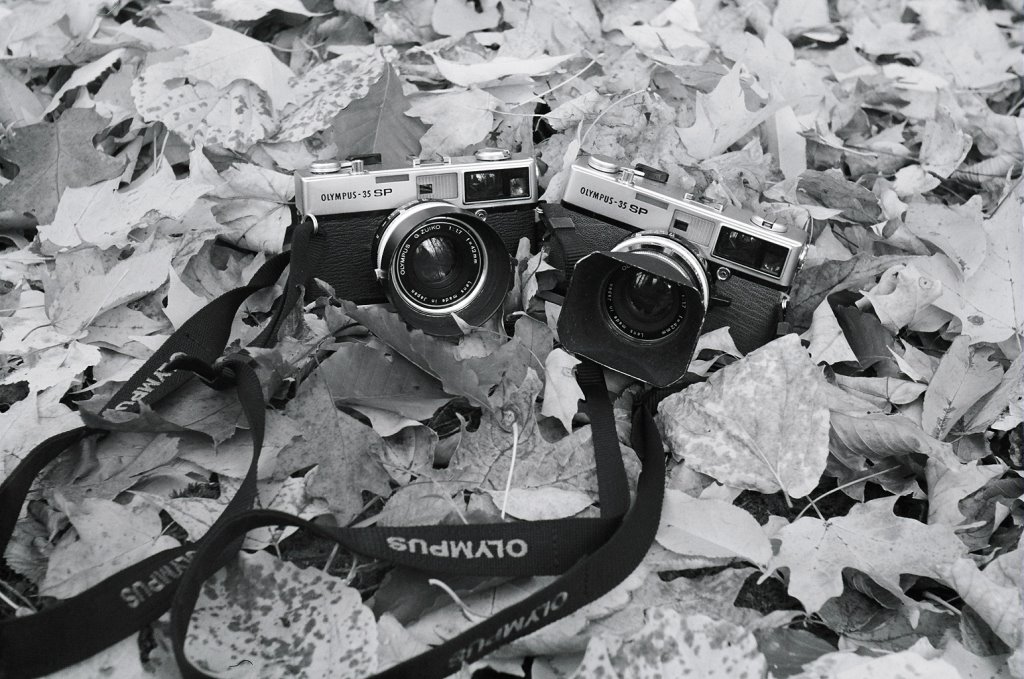
Interesting times, but my Olympus 35 SPs have a spotmeter and my head can do matrix metering calculations. Betcha I can't get that in a cameraphone.

Another problem is that photofinishers have been moribund in providing good service and being innovative. I'd post some ideas here, but they might actually make sense and be valuable. Hmmm.

Monday, January 16, 2006

Recreating a Room

A move (local only) is in the near future, so getting the house de-cluttered (Lord, where DID all the stuff come from?), painted and repaired is absolutely necessary. This weekend the living room got painted and a lot of unnecessary shit was either tossed or boxed up. New paint (from a pale blue to Glidden's "Water Chestnut") went on the walls, and all the furniture was totally rearranged so that the room was "opened up". The new TV was installed on a coffee table and placed into a corner, with the components on the shelf below. Looks cool.

So, what about the TV? I'm happy. The only problems I had were:

1. It appeared that the component inputs weren't working.

2. I tried to get ahold of Syntax support to no avail. Their technical support call queue kicks you out after a very few minutes, forcing you to select an option from the IVR. If you go to the operator, you're often as not on hold and then have to back to the IVR for another ineffectual selection.

Of course, it didn't occur to me that I was calling during CES, the holy grail of trade shows for a company in this market. Once I realized this, I sort of understood what was going on, BUT the operator (once I got ahold of her) could have explained.

Email didn't work very well either, and I resorted to multiple email submissions and then emailing the PR contact at the parent company, which I found via a company press release.

Bottom line, I got the problem resolved, but it took far too long. Minus for customer service.

As far as performance goes, however, I am very happy. Image quality is very good, with the factory defaults being quite good. Yes, I've tweaked it a bit, but all the settings are easy to get to via the menu system. I do not have any high def content yet (another story), but SD images are not bad for an LCD/fixed pitch display which has to convert.

The most surprising discovery is the audio performance. I don't expect very good sound on a TV. No, it's not true HiFi, but it's actually quite good for a TV monitor. There are quite a few effect settings, most of which (all but one) are hokey, but with no EQ setting or on "pop", sound quality is better than average by far ... at least in my experience. The audio out is fixed, meaning you need to control volume via whatever amp/receiver it is feeding. It makes sense, but since I can't program my satellite receiver remote to control our current receiver, it's a PITA having to have 3 remotes.

I hope to have HD content by Saturday evening for HNIC. That's when I'll be able to better judge video performance, especially how it handles motion. The set has "Super in Plane Switching" (Super IPS) to minimize smear of fast-moving images such as a puck on the ice.

All-in-all, so far I can recommend this set. Time will tell regarding reliability, but the build quality seems very high, on a par with major brand names.

Saturday, January 07, 2006

New TV

I've been lusting after an HDTV for a couple of years now. I'd been living with a Sony 27" stereo dinosaur since about 1996. It was pretty spiffy at the time, having S Video input, and in 2001 I bought a JVC SVHS tape deck to compliment it and the satellite receiver which had S-video output.

Everything was was fine until I got married and we made the decision to use live in her house and sell mine. The layout of the living room is long and narrow, with a fireplace at one end and the main entrance at the other. So the only place to put the TV is along a long wall, with a sofa against the opposite wall.

The result is a crowded room if you have a coffee table in front of the couch. That 27" TV isn't big by today's standards, but a CRT set is deep, so the footprint isn't really good for a smaller room.

The solution? Flat screen of course! I used this argument on my wife for a long time ... "It will save space!" I repeated over and over. Plus, I had upgraded my satellite receiver to a High Def model, largely because the slightly larger dish that came with it meant I might improve my signal strength.

I have been watching reviews and comments on the Olevia brand of LCD TVs from Syntax Groups for almost two years. An "off" brand, it was cheaper by a wide margin that competing brands with similar specs. But I was wary, of course. And even the lower price point was still too for quite some time.

On Christmas day, however, I saw that the LT32HVE model was on sale on radioshack.com and had a $300 rebate. I was wary of having something this expensive shipped to my house. Obviously I'd want to be there to receive it, but arranging that would be something of a hassle. So I waited to the next day and went to a local Radio Shack to see if they had stock. They don't stock TVs that large, but they did say I could have it shipped there as long as I picked it up promptly, as they had limited storage.

So I went home and ordered it. A 10% off offer was no longer available :( but it was still a good deal.

It arrived on the January 3. Today I received a DVI cable to use as the connection from the receiver and the picture is closer to optimal than with S-video. But I don't have high def programming downloaded to the receiver yet (another story), so I can't really give a valid review. Once I get that sorted, I'll post some comments. One thing I have noticed is that the control of colour temp is very good. Watching HDIC right now, the flesh tones are right on, reds are not over saturated; the balance is very good.

Friday, January 06, 2006

Hockey Day in Canada (HDIC)

One of my other passions is hockey. The Stanley Cup is the epitome of a championship ... four rounds, 7 games each round, at the end of a grueling 82-game regular schedule. Men play hurt, come up huge, skate on pure grit and adrenalin.

But the real story of hockey is not just the NHL, the AHL, or other pro leagues. It is the Junior teams and those "below". A couple of years ago, driving along highway 18 in January in western New York, I passed a bunch of kids playing pond hockey in a farmer's field. Classic across Canada, more rare in the US. It was a magical moment for me, just seeing those kids out there having pure fun.

On January 7th, CBC will broadcast Hockey Day in Canada (http://www.cbc.ca/sports/hockey/hdic2006/), a celebration of the game at the grassroots level. I'll sit in front of my new LCD TV, eating homemade chipotle chili, watching kids in Stephenville, Newfoundland play the game and adore heroes like Wendell Clark, Don Cherry and Darcy Tucker. And there will be other stories all across Canada that will literally bring tears to my eyes. I'll record it to DVD (I've recorded past years' broadcasts on tape; now I'm "with it") so I can cry again later.

This stuff is purity of life.

Tuesday, December 06, 2005

Scan Disappointment

Monday I picked up the CD of the K64 and some E6 scans. Very disappointing. Most of the K64 scans were very soft (unsharp, but beyond the typical digital softness), density was off (overall level was too low), etc. Some of the E6 scans are very sub-par as well. Back I go tomorrow to have many of them redone.

I realize there's a difference between scanning negatives and slides. But this is a QC issue. A professional lab shouldn't let such work out the door.

Hence, no new images to post yet.

Thursday, December 01, 2005

More retro/film shots coming

Or .... Mama don't take my Kodachrome away.

The shots in the "Recent Photos" entry were, as I stated, made on Fuji Reala 100 film, a colour negative product. In the other Olympus 35SP, I had Kodachrome 64 loaded. Kodachrome is my favourite film, all-time. Kodachrome 25 was the best, but it is sadly gone. Except rolls or "bricks" of rolls that have been frozen and are now offered for sale on eBay for more money than I can justify without having a professional assignment to pay for it.

So now only Kodachrome 64 and Kodachrome 200 are left, and who knows how long those will last. Kodak may announce its demise at any time. Living only a couple of miles from the Yellow Father's head office, I should be down there daily with a picket sign stating "Save film! (well, at least K64, and PLEASE bring back Panatomic X)". Yeah, like the new Kodak CEO, who came over from that photo giant HP will smile and NOT have me removed from the front of their premises.

Anyway, some of the K64 shots are at the lab being scanned, so I'll be able to post a comparison with the first (the horizontal) shot. Most people will yawn, but when I look at an original Kodachrome slide (not a scanned image on a computer), I get real calm. OMmmmmm.

Sunday, November 27, 2005

Thanksgiving

Thanksgiving. American style. In the Midwest.

We did it again. Went to the Midwest to spend a couple of days surrounding Murkin Thanksgiving with family. Now, I love my parents. And I love my siblings and their children. But love doesn't mean complete comfort level, of course. For a person who grew up in the "heartland" of the Excited States but who is now extremely uncomfortable with the values and lifestyle thereof, I sometimes question why I return and subject myself to discomfort.

The easy answer, of course, is that my parents aren't getting any younger. . . not that I am, either, of course. And while it means a lot to them for us to visit from time to time (especially since long travel isn't something they do as often as they used to,) seeing them and spending some time before they move on is important to me.

So what about the discomfort? Where does it come from? First, the what.

Attitudes, beliefs and behaviour of some of my family members. Some things really cause me pain. Illiberal, judgmental attitudes ... the negative point-of-view that is either explicit or lurking, waiting in the wings. Writing people totally off because they hold views or have lifestyles that are very different.

But why should this bother me so much? In point of fact, I've been somewhat depressed as a result since returning. I even had to get out of the house today to get some solitude. It had nothing to do with my wife, I just needed some solitude.

The why, I think, has to do with attachment. In Buddhist belief and understanding, attachment is at the root of suffering. Or at least, that's my understanding. I have only the most rudimentary understanding of Buddhism, but it is an understanding I will be seeking to expand.

Basically, it seems that being attached to a thing or being, in either a positive or negative way, is what can cause suffering. It is being invested in that object or being such that its nature or actions have a power over one, thus having a type of control.

As a final note, my spiritual views are informed by what I have called "Native American spirituality". I'm not sure that's an accurate or even appropriate term. I see great synergy between that perspective and Buddhism. It will be interesting to see how this develops.

Saturday, November 19, 2005

Recent Photos


In my first entry, I noted that I had started back on the road to photo recovery. Recently I have used my two Olympus 35SP cameras to shoot Kodachrome 64 and some Fuji Reala 100. The former is, of course, a transparency or slide film, aka a "chrome". The latter is a fairly low speed (by current standards) colour print film.

The 35SP is a vintage 1969-73 camera. As a rangefinder (RF), you do not view through the lens, but rather through a viewfinder window on the back of the camera's top plate. Focusing is manual, via aligning two images together in a central RF "patch". In other words, doing this finds the range, or distance of your focus point. This is a time-honoured and very accurate way of focusing, provided the RF mechanism is aligned properly. (I had both my SPs undergo a CLA [Clean Lubricate Adjust], so they are both accurate, with spot-on meters and shutters.) This method is especially useful in low light. And because there is no mirror as is necessary with an SLR, there is less noise and vibration when an exposure is made. So RFs (e.g. Leica, Contax, the new Zeiss-Ikon [drool!] and a host of others) are great for street shooting, discrete situations, etc.

The 35SP has a fixed lens, i.e. it is not interchangeable, as with a Leica, Contax, or ZI. The lens is a really sharp 42mm f1.7 G. Zuiko. (The G signifies that it has 7 glass elements, G being the 7th letter of the English alphabet.) 42mm is about the perfect focal length in 35mm photography to approximate the human field of view without peripheral vision. For much of my work in the past I have preferred a 35mm focal length; the slightly wider perspective provides some extra context, and is similar to what you perceive with that peripheral vision that the 42 (or up to 50mm) does not.

But in the last year or two I've considered that the "normal" (42-50mm) focal length has its merits. The perspective is enough different to force you to see differently when composing. And the slightly longer focal length, combined with the fact that these normal or "standard" lenses usually come with a wider aperture that limits depth of field, makes for some versatility when you need to isolate the subject by ensuring that the background is pleasantly out of focus.

In addition, I consider it a really important practice to really master a piece of equipment. So I make a point of often going out with a camera and only one lens. I.e., if I go out with an SLR, I can take along any number of different lenses. Choice is good, but the discipline of not having the choice of "which lens do I use?" has its own merits. It forces you to truly see, not just use gear.

Years ago I pretty much mastered the 35mm lens and the 100mm lens. Too bad I didn't master the 50mm (or nearly 50mm), since those are often both technically wonderful and cheap. (35mm camera manufacturers have made more 50s than any other focal length. They got good at the optical formulae, and they got good a production efficiency. Olympus produced at least five differnet 50mm/f1.8 lenses for the OM series. Then there were several versions of the 50/f1.4, the 55/f1.2, the 50/f1.2, the 50/f2 macro, and the 50/f3.5 macro. All were at least very good lenses. Even the early 50mm/f1.8 F.Zuiko, the least well regarded, had its charms. Wide open it wasn't great, but with its single coating (versus multi-coating), it had a glow and colour signature that was unique in the family. Use it with black and white film at mid-apertures, and you get a classical look.

So, I'm back to concentrating on the standard focal length, and the 42mm on the SP is a compromise between the 50 and 35. Sure, I'll use a different lens when the situation demands it, such as a super-wide for a large group shot, a 100mm for a tighter portrait and/or better background separation. But I'm going to wear the standard lens around my neck for awhile and let it teach me.

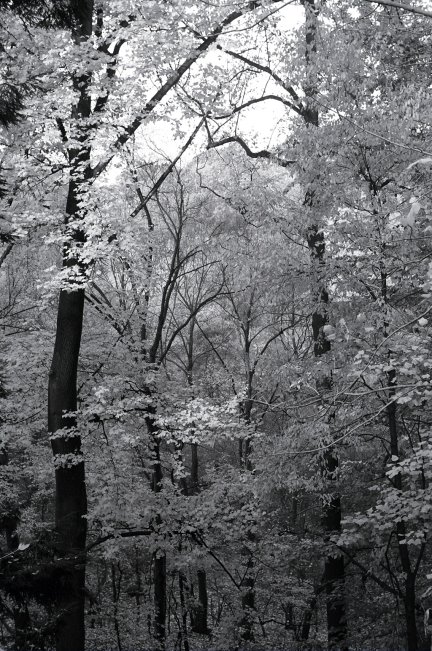
That said, I've posted a couple of recent shots above, made with the Olympus 35SP (body #1), shot on Fuji Reala 100 print film. The lab scanned the shots to high resolution TIFF files, and I then downsized and supplied minimal sharpening in Photoshop. My PS skills aren't well-developed, but I think they look OK. Both were taken at Durand Eastman Park in Irondequoit, NY, 05 Nov 2005.


Friday, November 18, 2005

Why in the world am I doing this?

Actually, I'm not entirely sure. And no, I'm not going to tell you exactly who I am, where I live, etc. Not that I am hiding anything, but it's just more fun this way. Besides, those who know me will figure out those bits right away; I guarantee there will be lots of hints from the get-go.

The executive summary: I need to remake my life, both physically and mentally because the way I am living is preventing me from doing a lot of the things I love.

In the past I have worked at several jobs/professions. One of those was as a professional photographer. I didn't do weddings or portraits. Weddings are too high pressure, and the portrait market was too cliché and boring. I did a lot of documentation and illustration work. Most of my income came from legal work, documenting personal injury cases. There was never any greusome work. Mostly I photographed traffic accident scenes well after the accident. Lines of sight, highway signage, etc.; these were things that would be needed as exhibits in a trial. Often I had to testify in court as to the veracity of the photos, how, when and where they were made, etc.

The pay was good, and it allowed me to do other work that didn't pay well or not at all, such as personal work. I was good at what I did, but not much of a self-promoter or business person, so I wasn't really making a living. I was stressed out and decided to quit photography as a business before I started hating the art of making pictures.

It was a good decision. My interest in photography has lain dormant for many years, but it has survied thanks to that decision. Some of the equipment that remains (I sold a lot of my gear) developed problems like fungus on lens elements, etc. So now that I have a desire to make pictures, to express myself creatively, I'm having to rebuild some of my inventory. That's not difficult thanks to a certain auction site on the internet. It just takes a bit of cash and some patience. (Actually, it is a bit more complicated since I discovered an email list of people who are owners of the particular brand of 35mm equipment I use. In addition to being a bunch of very good photographers, they are even better at "enabling" the addiction to the equipment, which is of extremely high quality. I really DO need all three speeds of the 28mm wideangle. But I can quit, anytime, I swear...)

A bit more difficult is the issue of the darkroom. My current digs don't really have a space that can easily be used for a darkroom. I have not warmed to digital workflow. I am not against it, but my primary interest in black & white, and the workflow for digital B&W just isn't as good as colour. But more importantly, I don't want to make the investment in learning digital printing techniques that meet my standards. I can be far more productive using the knowledge and skill I took so long to learn. New technique can come later.

What does this all have to do with the "executive summary"? Well, I'm out of shape. Like 75% or so of all western adults, you say.... so what? Well, I have a disadvantage to start with. Due to a disease I contracted in infancy, I pretty much lost the use of my left leg. As I grew up, my weight outgrew its ability to bear weight, so I had to start using a crutch. So my mobility is limited, but I've always been able to adapt to that. But the other consequence of effectively having only one leg is that extra weight is amplified. I don't know the amplification factor for physical effort, but there is an emotional dimension too. Fatigue can open the door to depression, even mild in nature. For an emotional eater (I am), that can set up a vicious circle. Add a heart attack (full recovery) that has diminished my ability to pump corpuscles, and you get the picture. Oh, and I am a bit of a foodie; I love to cook and have meals with really good wine. Our current kitchen (yes, I am married) is not an inviting workspace for me, so I don't cook as much as I used to. Which sets up the "need" to make food that is quick and easy to prepare. Not a recipe for weight control.

So, my mission is to get to where I need to be. How much overweight am I? I don't know exactly. I have a decent idea how much I weigh (I'll get on the scale in the next day or so and peg a starting point), and I can look up my ideal weight/BMI in some sort of chart. But I instinctively know that I need to target 11-13 kg. If I dropped 9 kg I know I'd feel very good. But I want to be in great shape, not just good enough. I want to be in the top 5% for my age, considering the limitations of my disability. I'd like to prove that by paddling my canoe (open, not kayak) across one of the great lakes that is just outside my door.

What I would like from anyone who might read my blog is a bit of support, and maybe some helpful hints on nutrition and conditioning. And this is a NO ATKINS ZONE, so if you want to promote that low-carb, high protein/fat approach, don't waste our time. One heart attack is enough, thank you very much.

Update: I began this post way back in February 2005, and it's now mid-November. Since that time, I've made good progress in getting my photographic life in shape. "New" old equipment, some of it quite sexy just to hold, a stash of film, and shooting semi-regularly and getting my "eye" back. Some of the gear has been CLA'd (Clean, Lubricate, Adjust) and even recovered with fresh, luxurious leather. Some is just as is but in perfectly useable condition (for example, a 28mm/f2.8 lens for $11 that works very well) some still needs TLC, such as a German rangefinder from 1954 that has a very dirty viewfinder but otherwise in wonderful condition. German glass is special!

Not so much progress on the weight, but I've started! I wasn't quite as bad as I thought, and I've dropped about 1.5 kg what I'd like to lose. The key is, I know I can do it, and I have started. The next part will be to start "working out" and getting better exercise. Part of that requires clearing out the big room in the basement so I can do some weight work. I've started, but ugh, there's a lot left.